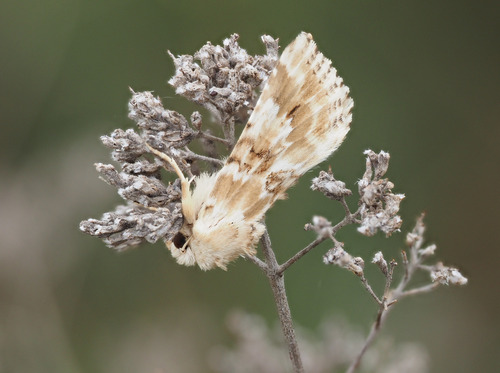
Dusky Sallow
Eremobia ochroleuca
A master of grassland camouflage, the Dusky Sallow features stunning marbled wings in shades of ochre and gold. Look for this twilight traveler visiting wildflowers in your garden during the height of summer.
Quick Identification
Size
Wingspan of 30–37 mm (1.2–1.5 inches); total body length approx. 15–20 mm (0.6–0.8 inches)
Colors
A marbled mix of pale ochre, creamy buff, and warm tan; features a dark brown central band and distinct pale kidney-shaped (reniform) spots.
Key Features
- Intricate marbled pattern of ochre and brown
- Distinctive pale, wavy transverse lines on forewings
- Rests with wings tented in a roof-like shape
- Slightly scalloped or 'ragged' outer wing edges
When You’ll See Them
Geographic range
Where Does the Dusky Sallow Live?
The Dusky Sallow is a classic inhabitant of the temperate regions of Europe and the Middle East. Its core range extends from the British Isles across Central and Southern Europe, reaching as far east as Turkey and Iran. While it is a resident across most of its territory, it has shown a notable northward expansion in recent decades, colonizing new grassland areas in Northern Europe as climates shift.
Basemap © OpenStreetMap contributors
Behavior
The Dusky Sallow is a nocturnal moth that exhibits fascinating crepuscular behavior, often becoming active just as the sun begins to set. Unlike many moths that remain hidden until total darkness, this species is frequently observed visiting flowers like thistles and knapweed during the 'blue hour.' Its flight is purposeful and steady as it moves between nectar sources, though it can be quite skittish if approached with a bright white light.
During the daylight hours, the Dusky Sallow relies on its remarkable camouflage. Its marbled buff and brown pattern mimics the appearance of dried grass seed heads and withered vegetation. It typically rests head-down on the stems of tall grasses, becoming almost invisible to predators. While it is a solitary species, you may find several individuals in a single patch of prime habitat during the peak of the breeding season.
EverydayEarth exclusive
Camera Tips
Capturing a high-quality image of the Dusky Sallow requires a specialized approach because of its small size and nocturnal habits. The most effective method is to set up an AI-powered camera near a light source, such as a UV moth trap or a simple white sheet illuminated by a porch light. Position your camera on a tripod approximately 12 to 18 inches from the surface where the moths land. If your camera has a macro setting, ensure it is engaged to capture the intricate marbled details of the wings.
For those who prefer a more natural setting, aim your camera at nectar-rich flowers like knapweed or thistles during the peak flight months of July and August. Since these moths visit flowers at dusk, you can often capture them in natural light before the infrared flash is required. Use a high-sensitivity trigger setting, as the small mass of a moth may not always trip standard PIR sensors. If your camera allows for it, a short video clip (5-10 seconds) is often better than a still photo, as it captures the characteristic 'shiver' of the wings before the moth takes flight.
To get the best color representation, use a 'No-Glow' infrared camera or one with a dedicated evening mode. Standard IR flashes can sometimes wash out the delicate ochre and buff tones of the Dusky Sallow, making it look like a generic brown moth. Placing your camera setup near a patch of tall, unmown grass will increase your chances significantly, as these are the primary breeding and resting grounds for the species.
Similar Species
Species that look similar or are commonly confused with Dusky Sallow.
Frequently Asked Questions
Record Dusky Sallow at your habitat
Connect a camera to start building your own species record — AI identifies every visitor automatically.