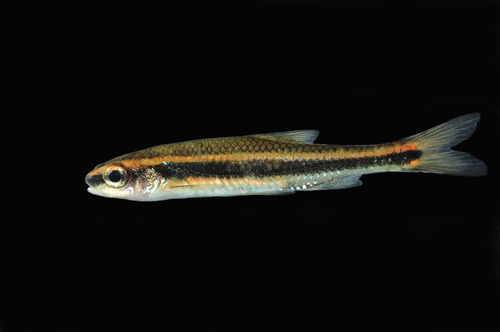
Dusky Shiner
Pteronotropis cummingsae
A shimmering inhabitant of the Southeast's mysterious blackwater streams, the Dusky Shiner is a master of the slow-moving current. With its sleek lateral stripe and seasonal flashes of color, this endemic minnow is a vital link in our coastal ecosystems.
Quick Identification
Size
A small minnow typically reaching 4.5–6 cm (1.8–2.4 inches) in length, with a maximum of about 7.2 cm (2.8 inches).
Colors
Olive to dusky brown back with a prominent dark lateral stripe extending from the snout to the base of the tail. Breeding males develop striking orange or reddish tints on their fins and a more yellowish hue on their lower bodies.
Key Features
- Distinct dark lateral stripe through the eye to the tail
- Slender, laterally compressed body
- Usually 10-11 anal fin rays
- Small, terminal mouth oriented slightly upward
When You’ll See Them
Geographic range
Where Does the Dusky Shiner Live?
The Dusky Shiner is a native gem of the North American Southeastern Coastal Plain. Its core range spans from the lower Tar River drainage in North Carolina, extending south through the river systems of Georgia and into the St. Johns River drainage in Florida. It is also found moving westward through the panhandle of Florida and into the Choctawhatchee River drainage in Alabama. It is endemic to this specific region and has not been introduced elsewhere.
Basemap © OpenStreetMap contributors
Behavior
The Dusky Shiner is a social, schooling species that navigates the sluggish, often tea-colored waters of the Southeastern United States. Unlike some of its more aggressive minnow cousins, the Dusky Shiner is relatively peaceful, spending its time hovering near submerged vegetation or woody debris where it can easily dart away from larger predators like bass or pickerel.
During the spawning season, which typically spans from late spring through summer, these fish become much more active and visible. Males will congregate in clearer patches of water or near the nests of other fish species to broadcast their eggs. They are highly attuned to water quality and flow, preferring the 'blackwater' environments created by decaying organic matter in coastal plain ecosystems.
EverydayEarth exclusive
Camera Tips
Capturing the Dusky Shiner requires an underwater approach, as traditional trail cameras won't trigger through the water's surface. Use a waterproof action camera or a dedicated underwater AI-powered camera. Because these fish inhabit 'blackwater'—which is stained dark by tannins—visibility can be a challenge. Place your camera in shallow areas (1-2 feet deep) where sunlight can penetrate the water column, ideally between 10 AM and 2 PM when the sun is directly overhead.
Position the camera on a weighted tripod or a flat rock facing a patch of submerged aquatic vegetation or a fallen log. These structures act as natural focal points for schooling shiners. To attract them into the frame, you can gently disturb the upstream sediment to release natural larvae, or use a small mesh bag with crushed fish flakes or bloodworms tied just out of the camera's view but within the scent line.
Since PIR motion sensors do not work underwater, set your camera to 'Time-Lapse' mode with an interval of 5-10 seconds, or use continuous video if your battery allows. If using an AI-powered camera, ensure the lens is clean of algae; a quick wipe with a microfiber cloth before submersion is essential. During the summer spawning months, look for areas with slightly higher flow or sandy patches where the males might congregate, as this offers the best chance for high-action footage.
Similar Species
Species that look similar or are commonly confused with Dusky Shiner.
Taillight Shiner
The Taillight Shiner has a very distinct, dark rectangular spot at the base of the tail, whereas the Dusky Shiner's stripe simply ends at the tail.
Sailfin Shiner
Sailfin Shiners have a much taller, more dramatic dorsal fin, especially in males, compared to the more streamlined Dusky Shiner.
Frequently Asked Questions
Record Dusky Shiner at your habitat
Connect a camera to start building your own species record — AI identifies every visitor automatically.