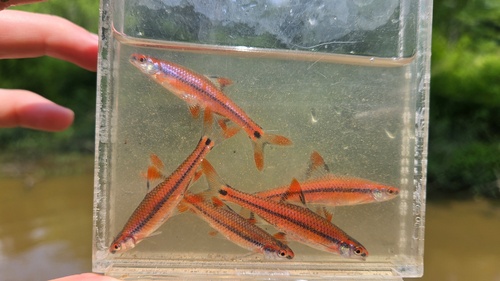
Taillight Shiner
Notropis maculatus
A shimmering jewel of Southern slow-waters, the Taillight Shiner is easily identified by the bold black 'beacon' at the base of its tail.
Quick Identification
Size
A small, slender minnow typically reaching 2 to 2.5 inches (5-6.5 cm) in length, rarely exceeding 3 inches (7.6 cm).
Colors
Silvery-white belly with an olive-yellow back; a prominent black lateral stripe ends in a distinct, large black spot at the base of the tail. Breeding males develop striking red coloration on the fins and snout.
Key Features
- Large, round black spot at the base of the tail fin (the 'taillight')
- Slender, compressed body with a silver-to-olive sheen
- Large eyes relative to head size
- Blunt snout with a terminal mouth
When You’ll See Them
Behavior
The Taillight Shiner is a gregarious, schooling species that spends most of its time in the mid-water column of slow-moving freshwater systems. They are known for their energetic swimming patterns and are highly social, often found in the company of other shiner species or sunfish. Unlike some more aggressive minnows, the Taillight Shiner is relatively peaceful and relies on its schooling behavior and speed to evade predators like bass and pickerel.
During the spawning season, which typically occurs from late spring through mid-summer, their behavior becomes more localized. They are known as 'nest associates,' often utilizing the nests of sunfish to deposit their eggs. This unique interaction allows the shiners to benefit from the protection provided by the larger male sunfish guarding the nest. In a backyard pond or slow-moving creek, they are fascinating to watch as they dart collectively in response to shadows or falling insects.
EverydayEarth exclusive
Camera Tips
Capturing the Taillight Shiner requires an aquatic setup, as these fish rarely break the surface. If you have a backyard stream or a managed pond, the best approach is to use a waterproof action camera or a specialized underwater trail camera. Position the camera in shallow water—roughly 12 to 18 inches deep—near the edge of aquatic vegetation like bladderwort or water lilies. These plants provide the cover that Taillight Shiners prefer, making them more likely to linger in front of the lens.
For the best lighting, angle your camera to face away from the direct sun to avoid harsh glints off the fish's silver scales, which can wash out the image. If you are shooting in the tea-colored (tannic) waters common in the Southeast, try to place a white or light-colored sandy patch in the background to help the AI-powered camera distinguish the dark lateral line and the signature 'taillight' spot of the fish. This contrast is vital for clear identification.
To bring the school into the frame, you can use a fine-textured 'chum' such as crushed fish flakes or a small amount of cornmeal dropped slowly near the camera site. Since they are diurnal, ensure your camera is set to record during the brightest part of the day when their iridescent scales are most reflective. Use a high frame rate (at least 60fps) if your camera allows it, as these minnows move with sudden, jerky bursts of speed that can appear blurry on standard settings.
Similar Species
Species that look similar or are commonly confused with Taillight Shiner.
Spottail Shiner
Has a smaller, more rectangular spot on the tail and a more robust, less compressed body.
Blacktip Shiner
Features dark markings on the tips of the fins rather than a prominent singular spot at the base of the tail.
Coastal Shiner
Lacks the distinct large black 'taillight' spot and generally has a more uniform silvery appearance.
Frequently Asked Questions
Record Taillight Shiner at your habitat
Connect a camera to start building your own species record — AI identifies every visitor automatically.