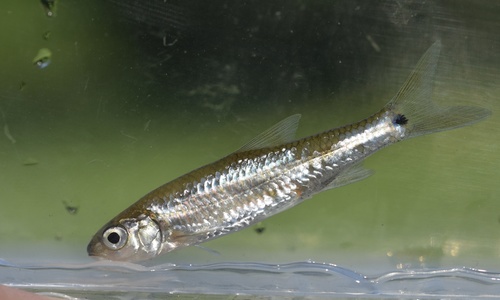
Spottail Shiner
Hudsonius hudsonius
The Spottail Shiner is a shimmering sentinel of our freshwater shores, recognized by the bold black 'thumbprint' at the base of its tail. These energetic schooling fish are a vital link in the underwater ecosystem, turning sunlight and insects into a feast for the lake's larger predators.
Quick Identification
Size
2 to 5 inches (5–12.7 cm) in length; rarely exceeds 6 inches (15 cm)
Colors
Silvery sides with a pale green to olive back and a white underside; features a prominent black circular spot at the base of the tail fin.
Key Features
- Distinct black spot at the base of the caudal (tail) fin
- Silvery, iridescent scales along the lateral line
- Subterminal mouth slightly angled downward
- Large, prominent eyes
When You’ll See Them
Behavior
The Spottail Shiner is a highly social, schooling species that plays a critical role in the aquatic food web. They are typically found in the clear, shallow waters of lakes and large rivers, where they move in coordinated groups over sandy or rocky bottoms. These schools act as a defense mechanism against larger predatory fish like walleye, pike, and bass, who rely on shiners as a primary food source.
During the day, they are active foragers, constantly scanning the substrate for small invertebrates. While they are relatively shy and quick to dart away from sudden movements or shadows, they are quite bold when feeding in a large group. In the early summer, they congregate in massive numbers near shorelines or creek mouths to spawn, casting their eggs over sandy or gravelly shallows.
EverydayEarth exclusive
Camera Tips
Capturing high-quality footage of the Spottail Shiner requires moving your camera beneath the surface. Because these fish are small and stay near the bottom, a waterproof action camera or a specialized underwater 'fish cam' is your best bet. For a backyard dock or shoreline, mount your camera to a weighted tripod or a PVC frame and lower it into 2 to 4 feet of water. Aim the lens horizontally across a sandy patch or a flat rock, as this is where shiners spend most of their time searching for food.
Lighting is the biggest challenge underwater. Try to time your recording for a bright, sunny day between 10 AM and 2 PM when the sun is directly overhead. This allows light to penetrate the water column, making the shiner's silvery scales 'flash' vividly against the darker background. If your camera has a high-frame-rate setting (such as 60 or 120 fps), use it; these fish move with incredible speed, and slow-motion playback will allow you to see the intricate details of their scales and that signature tail spot.
To bring the school directly in front of your lens, you can use a small amount of bait, such as crushed fish flakes or a mesh bag of breadcrumbs, placed just inside the camera's field of view. However, always check local wildlife regulations regarding 'chumming' before doing so. Positioning the camera near natural structures like submerged logs or the pilings of a pier can also be effective, as shiners often hover near these areas for protection from the current and predators.
Similar Species
Species that look similar or are commonly confused with Spottail Shiner.
Emerald Shiner
Lacks the black tail spot and has a much more slender, elongated body with a silvery-green iridescent stripe.
Bluntnose Minnow
Has a more rounded, blunt snout and a smaller, less distinct spot on the tail that is often more of a smudge than a bold circle.
Blackchin Shiner
Identified by a dark lateral stripe that runs through the eye and onto the chin, which the Spottail Shiner lacks.
Frequently Asked Questions
Record Spottail Shiner at your habitat
Connect a camera to start building your own species record — AI identifies every visitor automatically.