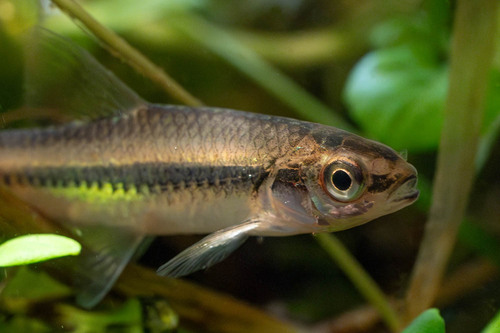
Blackchin Shiner
Miniellus heterodon
A delicate jewel of North American glacial lakes, the Blackchin shiner is a master of camouflage in underwater forests. Recognizable by its signature 'inked' chin, this small minnow is a gold standard indicator of pristine water quality.
Quick Identification
Size
Small minnow ranging from 5–8 cm (2–3.1 inches) in length; weighs less than 5 grams
Colors
Silvery-straw body with a prominent black lateral stripe that extends from the tail, through the eye, and onto the chin
Key Features
- Distinct black pigment on the tip of the chin and lower jaw
- Dark lateral stripe running the full length of the body through the snout
- Scales on upper back have dark edges creating a zig-zag pattern
- Incomplete lateral line that does not reach the tail
When You’ll See Them
Geographic range
Where Does the Blackchin Shiner Live?
Native to the temperate freshwater systems of North America, the Blackchin shiner is primarily centered around the Great Lakes basin. Its core range spans the northern United States and southern Canada, extending from the St. Lawrence River drainage westward through the upper Mississippi River valley. While once more common in the southern Midwest, its modern strongholds are now found in the clear, vegetated waters of Michigan, Wisconsin, Minnesota, and Ontario.
Basemap © OpenStreetMap contributors
Behavior
Blackchin shiners are social, schooling fish that spend their lives navigating the clear, vegetated margins of glacial lakes and slow-moving streams. They are highly dependent on submerged aquatic plants, which they use for both protection from predators like bass and pike, and as a substrate for finding their microscopic meals. They are generally peaceful and keep to the middle or upper layers of the water column, rarely venturing into deep, open water.
Unlike some of their bolder minnow cousins, the Blackchin shiner is quite sensitive to water quality changes and siltation. They are often considered an 'indicator species,' meaning their presence suggests a healthy, well-oxygenated aquatic ecosystem with low turbidity. While they don't interact with humans directly, they are a vital link in the food chain for larger game fish that lakeside residents enjoy watching.
EverydayEarth exclusive
Camera Tips
Capturing the Blackchin shiner requires an underwater approach, as these small fish rarely break the surface. If you have a backyard pond or live on a lake, use a waterproof action camera or a specialized underwater trail camera. Submerge the camera at a depth of 12 to 24 inches, positioning it near a bed of aquatic vegetation like pondweed or milfoil, where these shiners naturally congregate for cover.
To get the best clarity, aim the lens away from the sun to avoid glare and 'backscatter' from suspended particles in the water. A side-on (horizontal) angle works best to capture the diagnostic black stripe and chin pigment. Since they are small, try to place the camera within 6-12 inches of a known schooling spot. Using a 'macro' setting or a close-focus lens if your camera supports it will significantly improve the detail captured on their scales.
While you shouldn't use traditional bait which might cloud the water, you can 'lure' them by gently disturbing the sediment or shaking a patch of nearby vegetation, which releases small invertebrates into the water column and often triggers a feeding frenzy. The best time for filming is midday when the sun is directly overhead, providing maximum light penetration. Ensure your camera is set to a high frame rate (60fps or higher) to catch their quick, darting movements clearly.
Similar Species
Species that look similar or are commonly confused with Blackchin Shiner.
Blacknose Shiner
Lacks the black pigment on the chin; the lateral stripe does not wrap onto the lower jaw.
Ironcolor Shiner
Has a much darker, broader lateral stripe and a different dorsal fin position.
Pugnose Shiner
Has an extremely small, upturned mouth and lacks the extensive black chin pigment.
Frequently Asked Questions
Record Blackchin Shiner at your habitat
Connect a camera to start building your own species record — AI identifies every visitor automatically.