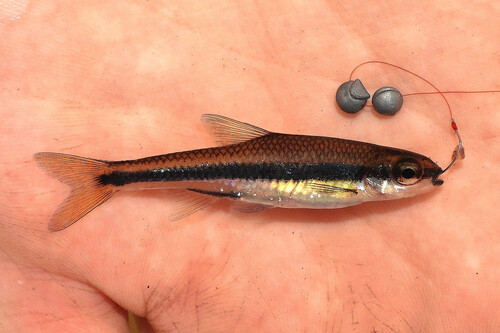
Ironcolor Shiner
Alburnops chalybaeus
A striking minnow of the American coastal plains, the ironcolor shiner is easily identified by the bold black stripe that runs from its tail right to its snout. This small but resilient fish is a master of the tea-colored streams of the East Coast.
Quick Identification
Size
Maximum length of 6.5 cm (2.5 inches); typically ranges from 4 to 5.5 cm (1.5 to 2.2 inches).
Colors
Silvery-straw body with a prominent, deep black lateral stripe running from the snout to the tail; breeding males develop orange or reddish tints in their fins.
Key Features
- Distinctive black lateral stripe extending through the eye and onto the snout
- Dark 'iron-colored' pigment inside the mouth and throat
- Slender, compressed body with a slightly upturned mouth
- Amber-tinted fins, particularly visible during the summer spawning season
When You’ll See Them
Geographic range
Where Does the Ironcolor Shiner Live?
The ironcolor shiner is native to the North American continent, primarily occupying the lowlands of the Eastern United States. Its core range spans the Atlantic and Gulf Coastal Plains, stretching from the Hudson River drainage in New York down through Florida and westward into the eastern portions of Texas. While it is most concentrated in these coastal regions, disjunct populations also exist further inland within the Mississippi River embankment and parts of the Great Lakes basin, specifically in Michigan and Indiana. Because this species relies on exceptionally clear water, its presence is often patchy and localized within these broader regions.
Basemap © OpenStreetMap contributors
Behavior
The ironcolor shiner is a gregarious, schooling fish that thrives in the mid-water columns of clear, slow-moving streams. Unlike many other minnows that stay near the bottom, these shiners are often found darting amongst submerged aquatic vegetation, which they use for both foraging and protection from predators. They are social creatures, typically found in groups of 10 to 50 individuals, often mixing with other shiner species.
During the spawning season, which typically runs from May through August, their behavior becomes more animated. They are known as 'nest associates,' frequently seen spawning over the nests of sunfish or other larger fish. While they are sensitive to water turbidity and pollution, they do not show much fear of human observers, making them a delight for snorkelers or underwater camera enthusiasts in clear-water habitats.
EverydayEarth exclusive
Camera Tips
Capturing the ironcolor shiner requires an underwater setup, such as a GoPro or a dedicated underwater trail camera. To get the best results, place your camera in shallow, slow-moving water near the edge of aquatic vegetation like eelgrass or lily pads. Positioning the camera at a slight upward angle towards the surface can help catch the natural light filtering through the water, which highlights the fish's silver scales and distinctive black stripe.
Since these fish are attracted to structure, placing the camera near a submerged log or a cluster of plants is more effective than placing it in open sand. You don't necessarily need bait, but a small mesh bag of crushed crackers or fish food can temporarily draw a school into the camera's field of view. Ensure the water is clear; these fish are rarely found in muddy or turbid environments, so a rainy day may ruin your footage by stirring up silt.
For the most vibrant colors, aim to record during the late spring and summer. This is when males exhibit their 'breeding dress,' showing off warm amber and orange tones in their fins that are far more striking than their winter silver. Use a high frame rate (60fps or higher) if your camera allows it, as shiners move with quick, darting motions that can appear blurred on standard settings.
Similar Species
Species that look similar or are commonly confused with Ironcolor Shiner.
Blacknose Shiner
The blacknose shiner lacks the dark pigment inside the mouth and has a less intense lateral stripe on the snout.
Dusky Shiner
Dusky shiners are generally deeper-bodied and lack the ironcolor's distinctive stripe-through-the-snout appearance.
Coastal Shiner
Coastal shiners have a much paler lateral line and a more rounded snout compared to the pointed snout of the ironcolor.
Frequently Asked Questions
Record Ironcolor Shiner at your habitat
Connect a camera to start building your own species record — AI identifies every visitor automatically.