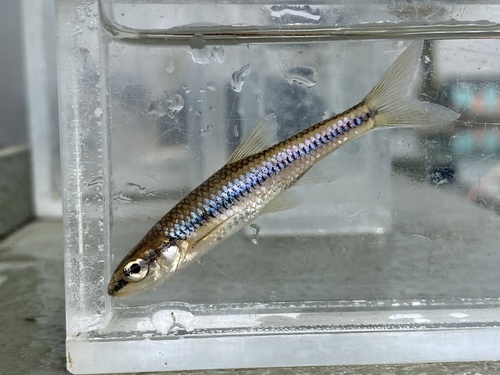
Blacknose Shiner
Notropis heterolepis
A delicate and striking indicator of pristine water, the Blacknose Shiner is famous for the bold black stripe that runs from its tail right to the tip of its nose.
Quick Identification
Size
2 to 3.5 inches (5 to 9 cm) in length
Colors
Silvery-white underside with a pale olive or straw-colored back; a prominent black lateral line runs from the tail, through the eye, to the tip of the snout.
Key Features
- Distinct black lateral stripe extending to the snout
- Scale margins on the upper body form dark crescent shapes
- Slender, slightly compressed body
- Small mouth that does not extend past the eye
When You’ll See Them
Geographic range
Where Does the Blacknose Shiner Live?
The Blacknose Shiner is native to the temperate regions of North America, found primarily across the northern United States and southern Canada. Its range stretches from the Atlantic slope in the east, through the Great Lakes and Hudson Bay basins, and as far west as the upper Mississippi River drainage in Saskatchewan and Nebraska. This species thrives in undisturbed, clear-water habitats, particularly in the northern tier of states like Michigan, Wisconsin, and Minnesota.
Basemap © OpenStreetMap contributors
Behavior
The Blacknose Shiner is a social, schooling species that is typically found in small groups navigating through dense aquatic vegetation. They are highly active during daylight hours, darting between plant stems to avoid predators like larger fish and birds. Because they are extremely sensitive to water turbidity and pollution, their presence is often used by biologists as an indicator of high water quality and a healthy ecosystem.
These fish are not aggressive and coexist peacefully with other minnow species. In a backyard setting with a stream or pond, you’ll observe them hovering in slow-moving currents or resting in the shade of lily pads. They rely heavily on their eyesight to hunt and to stay in formation with their school, making clear water essential for their survival.
EverydayEarth exclusive
Camera Tips
Capturing the Blacknose Shiner requires an underwater camera setup, such as a GoPro or a specialized trail camera with a waterproof housing. Because these fish are small and move quickly, place your camera in shallow water (6-12 inches deep) near a patch of submerged vegetation like Coontail or Pondweed. Use a weighted base or a small sandbag to keep the camera steady on the stream or lake bed.
Lighting is the most critical factor for a clear shot of this species. Position the camera so that the sun is behind the lens, illuminating the fish’s silvery sides and making the black lateral stripe clearly visible. Midday is the best time for recording, as vertical light penetrates the water column more effectively and reduces surface glare. Set your camera to a high frame rate (60 fps) to capture their rapid turns and schooling behavior without motion blur.
To attract a school into the frame, you can gently kick up a small amount of sediment upstream to release natural larvae, which will drift into the camera's view. Alternatively, a small mesh bait bag filled with freeze-dried daphnia or crushed fish flakes can be placed just out of the shot to keep the school lingering in front of the lens. Be patient; it usually takes 10-15 minutes for the fish to become comfortable with a new object in their environment.
Similar Species
Species that look similar or are commonly confused with Blacknose Shiner.
Blackchin Shiner
The Blackchin Shiner has a noticeable black pigment on its lower jaw (chin), whereas the Blacknose Shiner's chin is pale.
Ironcolor Shiner
Ironcolor Shiners have a much darker, deeper black stripe and the inside of their mouth is usually black.
Spottail Shiner
Lacks the full-length black lateral stripe through the eye and instead has a prominent dark spot at the base of the tail.
Frequently Asked Questions
Record Blacknose Shiner at your habitat
Connect a camera to start building your own species record — AI identifies every visitor automatically.