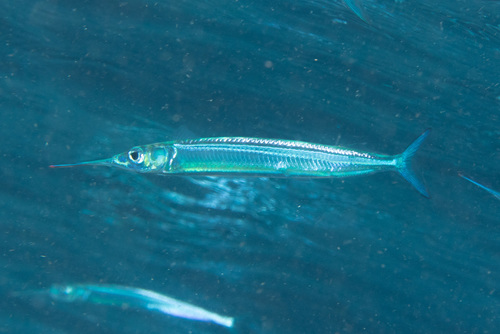
Dussumier's Halfbeak
Hyporhamphus dussumieri
A shimmering acrobat of the tropical shallows, the Dussumier's Halfbeak is easily recognized by its uniquely elongated lower jaw. These social fish are masters of the surface, skipping across the waves to evade predators in the coral lagoons of the Indo-Pacific.
Quick Identification
Size
Typically 20-30 cm (8-12 inches) in length, reaching a maximum of 38 cm (15 inches). They are very lightweight and slender.
Colors
Silvery-white underside and sides with a translucent quality; the back is a darker greenish-blue. A distinct silver-blue lateral stripe runs from the head to the tail.
Key Features
- Elongated lower jaw with a reddish tip
- Slender, cylindrical body
- Dorsal and anal fins positioned far back near the tail
- Large eyes positioned for surface viewing
When You’ll See Them
Geographic range
Where Does the Dussumier's Halfbeak Live?
Native to the vast Indo-Pacific region, Dussumier's Halfbeaks are found from the warm waters of the Seychelles and East Africa across to the Tuamotu Islands in French Polynesia. Their core range extends north toward Hong Kong and the Japanese islands of Okinawa, reaching as far south as the tropical northern coastlines of Australia. These fish are strictly marine and estuarine, thriving in the clear, shallow waters of tropical reef systems.
Basemap © OpenStreetMap contributors
Behavior
One of their most notable behaviors is their 'skipping' flight. When threatened by larger predatory fish or diving birds, they use their powerful tails to propel themselves out of the water, skittering across the surface to confuse the attacker. While generally timid, they are often seen congregating around docks and piers in calm weather, where they are attracted to the light and localized currents.
EverydayEarth exclusive
Camera Tips
Lighting is your biggest challenge and your best friend with this species. Because they are silvery and reflective, aim for mid-morning or mid-afternoon shots when the sun is at an angle; this reduces harsh glare from the surface while highlighting their iridescent scales. If your camera allows, use a polarizing filter to cut through the water's surface reflection. If you are filming from above the water, look for calm 'glassy' days where the fish's distinct lower jaw creates V-shaped wakes on the surface.
Attracting Halfbeaks is relatively simple because they are opportunistic surface feeders. Small amounts of floating fish food or finely chopped oily fish can draw a school into your camera's field of view. However, be careful not to overfeed, as the resulting 'cloud' of food can obscure the water clarity. For the best action shots, set your camera to a high frame rate (60fps or higher) to capture their lightning-fast darting movements and occasional jumps.
Pay close attention to the tides. Dussumier's Halfbeaks often move closer to shore and into mangrove areas during high tide to feed. If you are placing a camera in a tidal zone, ensure it is securely anchored and that the lens is clear of any floating seagrass or debris that often drifts in with the rising water. Checking your camera during a rising tide usually provides the most activity as the fish follow the influx of nutrient-rich water.
Similar Species
Species that look similar or are commonly confused with Dussumier's Halfbeak.
Frequently Asked Questions
Record Dussumier's Halfbeak at your habitat
Connect a camera to start building your own species record — AI identifies every visitor automatically.