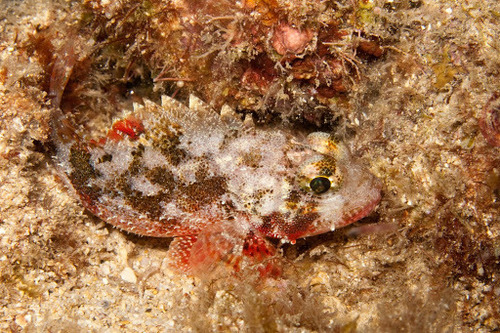
Dwarf scorpionfish
Sebastapistes fowleri
The Dwarf scorpionfish is a miniature marvel of evolution, using near-perfect camouflage to vanish into the tropical reefs of the Indo-Pacific. Though barely over an inch long, this tiny predator is a master of the ambush, waiting with infinite patience for the perfect moment to strike.
Quick Identification
Size
2.5 to 3.7 cm (1.0 to 1.5 inches) in length; weight is typically under 15 grams.
Colors
Mottled combination of white, tan, and reddish-brown blotches; camouflage varies slightly to match surrounding coral or rubble.
Key Features
- Minute size, rarely exceeding 1.5 inches
- Highly cryptic 'stone-like' camouflage
- Stocky head with large, upward-slanted mouth
- Venomous dorsal spines for protection
When You’ll See Them
Geographic range
Where Does the Dwarf scorpionfish Live?
The Dwarf scorpionfish is a widespread resident of the tropical Indo-Pacific. Its native range begins along the eastern coast of Africa and the Red Sea, stretching across the Indian Ocean to the coral-rich waters of Indonesia and the Philippines. In the Pacific, it is found as far north as southern Japan, throughout the Great Barrier Reef of Australia, and eastward to the Hawaiian and Pitcairn Islands, making it one of the most widely distributed small reef fish in the region.
Basemap © OpenStreetMap contributors
Behavior
The Dwarf scorpionfish is a quintessential ambush predator, relying almost entirely on its near-perfect camouflage to survive. It spends the vast majority of its time perfectly still, perched on coral branches or tucked into rocky crevices. Because of its tiny size, it is a sedentary species that rarely travels more than a few meters from its preferred hiding spot throughout its life. It is primarily solitary, only interacting with others of its kind during brief mating encounters.
Despite its sluggish appearance, the Dwarf scorpionfish possesses lightning-fast reflexes. When a small crustacean or larva drifts within reach, the fish expands its buccal cavity in milliseconds, creating a vacuum that sucks the prey into its mouth. In terms of human interaction, they are remarkably docile and will not move even if approached closely, though they should never be touched due to the painful venomous spines located along their dorsal fin.
EverydayEarth exclusive
Camera Tips
Capturing the Dwarf scorpionfish on camera requires a dedicated macro setup because of their minuscule size and incredible camouflage. If you are using an underwater trail camera or a stationary reef cam, place the unit on a weighted tripod as close to the substrate as possible. Focus your efforts on areas of 'coral rubble'—the broken bits of coral found on the edges of reefs—as this is where they are most frequently found hiding in plain sight.
Because these fish do not move for hours at a time, time-lapse photography is an excellent strategy. Set your camera to take a high-resolution image every 30 seconds. This allows you to capture rare movements or feeding strikes that you would likely miss with standard video. If your camera supports it, use a 'macro' focal setting to ensure the intricate patterns of their skin are crisp and clear.
Lighting is your biggest challenge underwater. If monitoring a specific crevice at night, use a red-filtered light source. Many reef inhabitants, including the Dwarf scorpionfish, are less disturbed by red light than white light, allowing you to observe their natural nocturnal hunting behavior. Ensure your camera is positioned at a slight upward angle to capture the profile of the fish against the water, which helps distinguish its shape from the confusing patterns of the rocks.
Similar Species
Species that look similar or are commonly confused with Dwarf scorpionfish.
Frequently Asked Questions
Record Dwarf scorpionfish at your habitat
Connect a camera to start building your own species record — AI identifies every visitor automatically.