Dwarf White Stripe Bamboo
Pleioblastus variegatus
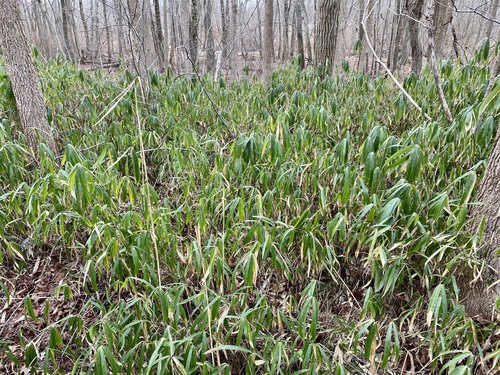
The Dwarf White Stripe Bamboo is a striking, low-growing plant known for its brilliant variegated leaves. It transforms garden floors into lush, striped carpets that provide vital cover for backyard critters.
Quick Identification
Size
30–90 cm (12–36 inches) tall; leaves 10–20 cm (4–8 inches) long
Colors
Bright forest green with longitudinal creamy-white or silver stripes; stems are greenish-purple
Key Features
- Striking white and green variegated foliage
- Low-growing, dense spreading habit
- Slender, upright culms (stems)
- Evergreen leaves in milder climates
When You’ll See Them
Geographic range
Where Does the Dwarf White Stripe Bamboo Live?
Native to the temperate islands of central and southern Japan, the Dwarf White Stripe Bamboo has been introduced widely as an ornamental groundcover. It is now commonly found across the eastern United States—particularly in Maryland, Virginia, and D.C.—as well as in parts of China, New Zealand, South America, and India. It thrives in humid, temperate to subtropical climates where it can find moist, well-drained soil.
Basemap © OpenStreetMap contributors
Behavior
Dwarf White Stripe Bamboo is a vigorous 'running' bamboo that spreads primarily through an aggressive network of underground rhizomes. This growth strategy allows it to quickly colonize open ground, forming dense, carpet-like thickets that serve as excellent low-level cover for small wildlife. In the garden, it is often used as a groundcover to brighten shady areas, though its spreading nature requires careful management to prevent it from overtaking other plants.
Unlike many taller bamboo species, this dwarf variety remains close to the ground, rarely exceeding three feet in height. It is incredibly resilient, surviving heavy pruning and even accidental mowing. In a backyard ecosystem, it acts as a structural foundation, providing a year-round microhabitat for insects and a safe haven for ground-dwelling animals during inclement weather.
EverydayEarth exclusive
Camera Tips
When using an AI-powered camera to observe wildlife around Dwarf White Stripe Bamboo, the best strategy is to mount your camera at a 'mouse-eye' level. Because this bamboo is so low to the ground, placing your camera 15 to 30 centimeters (6 to 12 inches) high will allow you to capture the small mammals, such as voles and shrews, and ground-feeding birds that use the dense stalks for protection. The white stripes on the leaves can be highly reflective, so try to position the camera lens in a spot that avoids direct midday sun to prevent blown-out highlights in your photos.
This plant is a fantastic natural 'blind' for your camera. If you place your camera on the edge of a bamboo patch looking toward a clearing or a water source, you can catch animals as they emerge from the safety of the foliage. During the night, the variegated leaves can sometimes interfere with infrared flash, creating a 'ghosting' effect if the leaves are blowing in the wind. To mitigate this, ensure the area directly in front of the lens is clear of loose foliage, or use a faster shutter speed setting if your camera allows it.
Seasonal changes also offer unique opportunities. In winter, this evergreen bamboo becomes a primary focal point for wildlife seeking shelter from the snow. A camera placed near a patch of Dwarf White Stripe Bamboo during a cold snap is likely to record significant activity as birds and mammals congregate there for warmth and protection. Setting your camera to 'Burst Mode' is recommended, as small creatures moving through the narrow culms can be very fast and easy to miss with a single shot.
Similar Species
Species that look similar or are commonly confused with Dwarf White Stripe Bamboo.
Frequently Asked Questions
Record Dwarf White Stripe Bamboo at your habitat
Connect a camera to start building your own species record — AI identifies every visitor automatically.