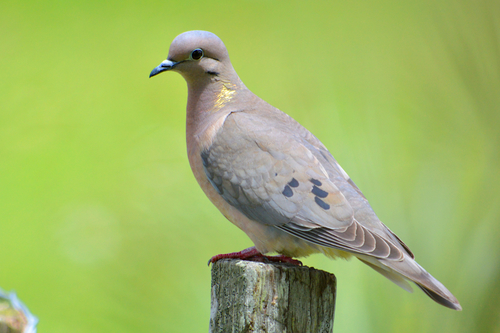
Eared Dove
Zenaida auriculata
South America's most common dove, the Eared Dove is a master of adaptation, famous for its gentle coo and the elegant black 'ear' markings that give it its name.
Quick Identification
Size
Length 22–28 cm (8.7–11 in); wingspan approx 42 cm (16.5 in); weight 110–115 g (3.9–4.1 oz)
Colors
Soft olive-brown upperparts, pinkish-buff breast, grey crown, and black spots on wings; iridescent violet-pink neck patches on males.
Key Features
- Two distinct black diagonal streaks on the face behind the eye
- Prominent black spots on the inner wing feathers
- Pointed tail with white or cinnamon-colored tips on outer feathers
- Iridescent bronze-pink patch on the sides of the neck
When You’ll See Them
Geographic range
Where Does the Eared Dove Live?
Native to the South American continent, the Eared Dove is a ubiquitous presence from Colombia and Venezuela all the way south to the central regions of Argentina and Chile. It is also common across the southern Caribbean islands, including Trinidad, Tobago, and the Grenadines. While it avoids the dense, humid interior of the Amazon rainforest, it has rapidly expanded its footprint into newly cleared agricultural lands and urban centers across the continent.
Basemap © OpenStreetMap contributors
Behavior
The Eared Dove is a gregarious and highly social species, often observed in large flocks that can number in the hundreds or even thousands near abundant food sources. They are primarily ground-dwelling foragers, moving with a characteristic rhythmic head-bob and a swift, dainty walk as they search for seeds. When startled, they take flight with a sudden, sharp whirring sound produced by their primary feathers, a trait common to many Zenaida species.
These birds are remarkably well-adapted to human environments, thriving in suburban gardens, urban parks, and agricultural fields. Their vocalization is a soft, mournful 'coo-oo, coo, coo,' which is a staple sound of the South American countryside. While they can be skittish around sudden movements, they frequently visit backyard bird baths and feeding stations, becoming quite bold once they recognize a reliable food source.
EverydayEarth exclusive
Camera Tips
To capture the best footage of Eared Doves, place your camera low to the ground, ideally between 12 and 18 inches high. These birds are strict ground-feeders, so angling the camera slightly downward toward a cleared patch of earth or a flat stone will provide the most natural shots. They are particularly attracted to areas with short grass or bare soil where they can easily spot seeds.
Using a 'feeding station' approach works wonders for this species. Scatter a mix of cracked corn, millet, or sunflower seeds directly on the ground in front of the camera. If you have a platform feeder, ensure it is low-profile. Eared Doves are also very fond of water; a shallow birdbath placed in a sunny spot will often attract them for both drinking and bathing, providing excellent opportunities for action shots.
Because Eared Doves move their heads quickly while foraging, set your camera to a fast trigger speed or use a burst photo mode to ensure sharp images. In video mode, a higher frame rate (60fps) is recommended to capture the beautiful iridescence of the male's neck feathers and the rapid wing-beat during takeoff. Early morning and late afternoon provide the best lighting to highlight their subtle pink and bronze hues.
Similar Species
Species that look similar or are commonly confused with Eared Dove.
Frequently Asked Questions
Record Eared Dove at your habitat
Connect a camera to start building your own species record — AI identifies every visitor automatically.