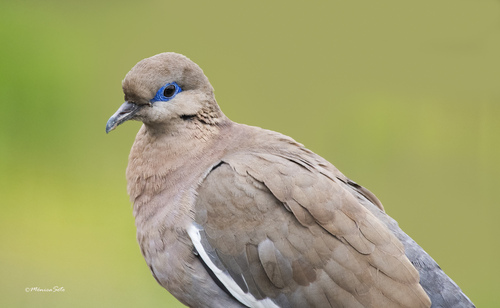
West Peruvian Dove
Zenaida meloda
With its soulful melodic song and striking blue 'eyeliner,' the West Peruvian Dove is a charming staple of coastal South American gardens. This resilient and social bird brings a touch of elegance to any backyard camera setup.
Quick Identification
Size
Length 28–30 cm (11–12 in); Wingspan 45–50 cm (18–20 in); Weight 150–200g (5.3–7 oz)
Colors
Soft grayish-brown body with a vinous (pinkish-purple) wash on the breast; distinctive bright blue bare skin around the eye; white patches on the wings; black spot on the lower ear coverts.
Key Features
- Bright cobalt-blue skin surrounding the eye
- Broad white patch on the edge of the wing visible at rest
- Heavy, slightly decurved black bill
- Square-ended tail with white tipping on outer feathers
When You’ll See Them
Geographic range
Where Does the West Peruvian Dove Live?
Native to the Pacific slope of South America, the West Peruvian Dove is a quintessential coastal species. Its core range extends from southwestern Ecuador through the entire coastal length of Peru and reaches into northern Chile. While it thrives in the arid lowlands, it also follows river valleys upward into the Andean foothills, appearing in virtually any environment where water and seeds are available.
Basemap © OpenStreetMap contributors
Behavior
The West Peruvian Dove is a highly social and adaptable bird, often seen in pairs or small groups. They are primarily terrestrial foragers, spending much of their day walking gracefully on the ground in search of food. When startled, they take flight with a characteristic whistling sound produced by their wings, revealing the bold white patches that give them their other common name, the Pacific Dove.
In urban and suburban settings, these doves have become remarkably bold. They are common fixtures in backyard gardens, city parks, and plazas, where they have learned to coexist closely with humans. Their vocalization is a defining feature of the coastal South American soundscape—a rhythmic, four-syllable cooing that is deeper and more melodic than that of the closely related White-winged Dove.
EverydayEarth exclusive
Camera Tips
To capture the best footage of West Peruvian Doves, position your camera at a low angle, roughly 12 to 18 inches off the ground. These birds are almost exclusively ground feeders, so aiming your lens at a clear patch of earth or a flat stone where you have scattered birdseed will yield the most intimate shots. A wide-angle setting is ideal to capture their social interactions, as they often feed in pairs.
Because these doves are active during the brightest parts of the day, avoid placing the camera in direct, harsh sunlight which can wash out the subtle purple iridescence on their necks. A dappled shade area under a tree or near a garden hedge provides the best natural lighting. If your camera has a 'burst' mode, use it to capture the moment they transition from walking to flight, which highlights the striking white wing bars.
Standard wild bird seed mixes containing millet and cracked corn are irresistible to these doves. If you want to encourage them to linger in front of the lens, provide a shallow water basin or birdbath nearby. They are frequent drinkers and will often spend several minutes preening after a drink, offering excellent opportunities for high-detail video. Ensure your trigger speed is set to high, as their initial take-off can be very rapid.
Similar Species
Species that look similar or are commonly confused with West Peruvian Dove.
White-winged Dove
Nearly identical in appearance but found primarily in North and Central America; its song is more nasal and less rhythmic than the West Peruvian Dove.
Eared Dove
Smaller with a shorter tail, lacking the blue eye-ring and the prominent white wing patches of the West Peruvian Dove.
Croaking Ground Dove
Much smaller and stockier with a very different 'frog-like' call and scaly patterns on the neck.
Frequently Asked Questions
Record West Peruvian Dove at your habitat
Connect a camera to start building your own species record — AI identifies every visitor automatically.