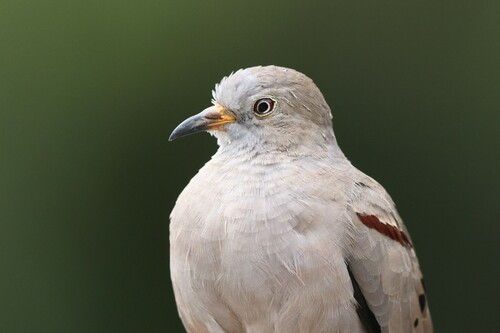
Croaking Ground Dove
Columbina cruziana
Meet the charming, frog-voiced resident of the South American coast. With its bright yellow bill and gentle disposition, the Croaking Ground Dove is a favorite visitor to backyards from Ecuador to Chile.
Quick Identification
Size
15-18 cm (5.9-7.1 in) in length; weight 42-55 g (1.5-1.9 oz)
Colors
Brownish-grey body, blue-grey crown, bright yellow-orange bill with a black tip, and black spots on the wings with subtle purple wing bars.
Key Features
- Bright yellow or orange-yellow base of the bill
- Distinctive blue-grey head and neck in males
- Small, stocky body with a relatively short tail
- Black spotting and a purple band on the wings
When You’ll See Them
Geographic range
Where Does the Croaking Ground Dove Live?
The Croaking Ground Dove is a signature species of the Pacific coastal regions of South America. Its native range stretches from the southwestern corner of Colombia through the coastal lowlands of Ecuador and Peru, extending as far south as northern Chile. Highly adaptable, it has expanded its presence into human-altered landscapes, flourishing in both the arid coastal plains and the lower elevations of the Andean foothills.
Basemap © OpenStreetMap contributors
Behavior
The Croaking Ground Dove is a social and highly terrestrial bird, often seen in pairs or small family groups. They spend the vast majority of their time on the ground, walking with a rhythmic, jerky head-bob as they search for seeds. Unlike many wild birds, they are remarkably bold and well-adapted to human presence, frequently living in close proximity to people in urban parks and suburban gardens.
Their name comes from their unique vocalization, which is quite different from the gentle cooing of most pigeons. Instead, they emit a low, rhythmic, frog-like croak. During the breeding season, males can be observed performing elaborate courtship displays where they bow repeatedly and fan their tails to show off their markings while calling out to potential mates.
EverydayEarth exclusive
Camera Tips
To capture high-quality footage of the Croaking Ground Dove, camera placement is everything. These birds are almost exclusively terrestrial, so you should mount your AI-powered camera very low to the ground—ideally between 4 and 6 inches high. Point the lens toward a flat, cleared area of dirt or short grass. They prefer open spots where they have a clear line of sight to spot potential predators like cats or hawks while they forage.
You can significantly increase your chances of a sighting by providing a ground-level water source. A simple, shallow ceramic dish or a low-profile bird bath is a magnet for these doves, especially in the arid climates they call home. For food lures, scatter a handful of fine cracked corn, white millet, or commercial wild bird seed directly on the bare ground. They are much less likely to use elevated tray feeders, so keeping the 'bait' at their level is key.
Lighting plays a huge role in identifying this species accurately. Their plumage includes subtle iridescent purple wing bars and a soft blue-grey head that can look washed out in harsh midday light. Position your camera to take advantage of the 'golden hour'—the soft, angled light of the early morning or late afternoon. This will highlight the bright yellow of their bill and the texture of their feathers, making for stunning captures.
Because these birds are active and often move with quick, jerky motions, set your camera to take short video clips (10-15 seconds) or high-speed bursts. This will allow you to capture their unique head-bobbing walk and the charming 'fanning' of their tails during social interactions. If your camera has a microphone, the low-frequency croaking call is a fantastic behavioral trait to record.
Similar Species
Species that look similar or are commonly confused with Croaking Ground Dove.
Frequently Asked Questions
Record Croaking Ground Dove at your habitat
Connect a camera to start building your own species record — AI identifies every visitor automatically.