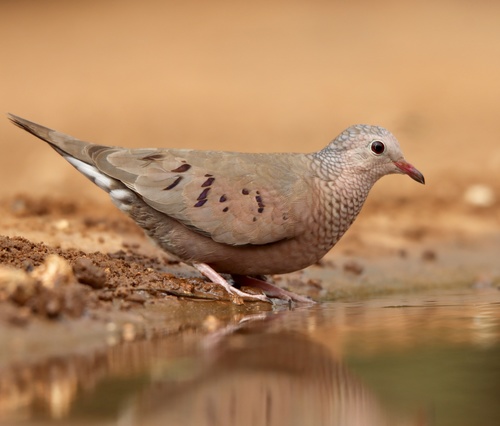
Common Ground Dove
Columbina passerina
The Common Ground Dove is North America's smallest dove, a charming ground-dweller known for its sparrow-like size and beautiful scaly plumage.
Quick Identification
Size
Length: 15–18 cm (5.9–7.1 in); Wingspan: 25–28 cm (10–11 in); Weight: 28–40 g (1–1.4 oz)
Colors
Sandy gray-brown overall; males feature a pinkish wash on the breast and blue-gray crown. Distinctive dark 'scaling' on the head and breast; rufous primary feathers visible in flight.
Key Features
- Diminutive size similar to a sparrow
- Scaly feather pattern on head and breast
- Short, square-tipped tail
- Bright cinnamon-red underwing patches visible during flight
When You’ll See Them
Sightings on EverydayEarth
Apr 26, 2026
A Clay-colored Thrush stands at the center of the wooden feeder, feeding on the provided orange halves. Shortly after, a small Common Ground Dove enters the frame from the right and begins to forage alongside it.
Geographic range
Where Does the Common Ground Dove Live?
Native to the warmer latitudes of the Western Hemisphere, the Common Ground Dove is a staple of the southern United States, stretching from the arid landscapes of southern California across to the humid coastal plains of Florida. Their core range extends through the Caribbean islands and across the entirety of Mexico and Central America. In South America, they are found primarily in the northern reaches, including Colombia, Venezuela, and parts of Brazil, where they thrive in year-round tropical and subtropical climates.
Basemap © OpenStreetMap contributors
Recorded on EverydayEarth
Behavior
The Common Ground Dove is aptly named, spending the vast majority of its day foraging on the forest floor or in sandy clearings. Unlike many other doves that prefer high perches, these birds walk with a distinctive, rapid head-bobbing motion, searching for tiny seeds. They are social birds, almost always seen in pairs or small family groups, though they rarely form the massive flocks seen in larger pigeon species.
While they are surprisingly approachable, they are also easily startled. When flushed, they take flight with a frantic, noisy fluttering of wings, revealing a sudden flash of reddish-brown primaries that serves as a distraction to predators. Despite their ground-dwelling nature, they are strong flyers and will retreat to low shrubs or fence lines when they feel threatened by human activity or local pets.
EverydayEarth exclusive
Camera Tips
To capture the best footage of the Common Ground Dove, camera placement is everything. Because these birds spend nearly all their time on the ground, you should mount your camera just 3 to 6 inches above the soil. Aiming the lens parallel to the ground or at a slight downward angle toward a sandy patch or a flat stone will provide an intimate, eye-level perspective that highlights their unique 'scaly' feathering.
Baiting is highly effective for this species. Scatter a 'fines' birdseed mix (containing white proso millet and cracked corn) directly on the ground in a sunlit clearing near brushy cover. These doves prefer foraging in the open where they can see predators, but they need to be within a quick flight of a bush or hedge. Avoid placing the camera in deep shade, as their sandy-brown plumage can easily blend into the shadows, making it difficult for AI motion triggers to distinguish them from the background.
Timing is also a crucial factor. They are most active in the early morning shortly after sunrise and again in the late afternoon. If you are using a camera with adjustable sensitivity, set it to high; because ground doves are small and move with quick, jerky motions, they can sometimes be missed by slower sensors. In the heat of summer, providing a very shallow ground-level birdbath—basically a saucer with half an inch of water—can be an irresistible draw for these thirsty birds.
Similar Species
Species that look similar or are commonly confused with Common Ground Dove.
Inca Dove
The Inca Dove has a much longer, white-edged tail and a more extensive scaly pattern across its entire body.
Mourning Dove
Nearly double the size of a ground dove, with a long, tapering tail and no scaly pattern on the breast.
Ruddy Ground Dove
Males are a much brighter, uniform cinnamon-red color and lack the heavy scaling on the breast seen in Common Ground Doves.
Frequently Asked Questions
Record Common Ground Dove at your habitat
Connect a camera to start building your own species record — AI identifies every visitor automatically.