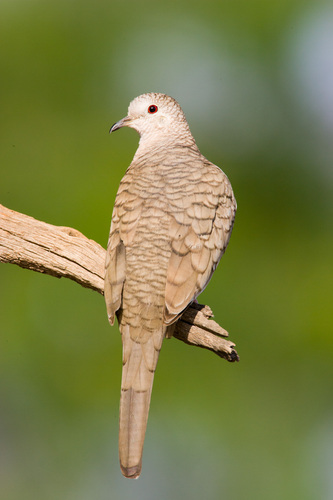
Inca Dove
Columbina inca
Admired for its delicate 'scaly' plumage and mournful two-note call, the Inca Dove is a charming fixture of Southwestern backyards. These slender, social birds are masters of the desert, often found foraging in pairs or performing their famous 'pyramid huddles' to stay warm.
Quick Identification
Size
Length: 6.5–9.1 in (16.5–23 cm); Wingspan: 11.2–12.6 in (28.5–32 cm); Weight: 1.1–2.0 oz (30–58 g)
Colors
Tan to gray-brown body with dark feather edges creating a scaly appearance; rufous (reddish) underwings; white outer tail feathers.
Key Features
- Distinctive 'scaly' feather pattern across the entire body
- Long, square-ended tail with white edges
- Slender, small-headed profile
- Cinnamon-red underwings visible in flight
When You’ll See Them
Sightings on EverydayEarth
Jun 19, 2026
A high-activity scene at the sanctuary's feeding area. Multiple White-winged Doves are perched on the crossbeam and landing at the feeder, while several smaller Inca Doves feed on the ground-level tray. An Acorn Woodpecker stays perched on the far left of the horizontal log, and a male House Finch is seen in the upper-left foliage.
Jun 2, 2026
A high-activity morning scene at the Ash Canyon Bird Sanctuary. Mourning Doves and smaller Inca Doves are foraging for seeds on the ground and lower platforms. On the left, a male House Finch is actively feeding from a tube feeder. Several Mexican Jays occupy the upper crossbars of the wooden station, while an Acorn Woodpecker is seen clinging to the central post. The birds appear comfortable and are frequently moving between the ground and the various perches.
May 31, 2026
A busy scene at the bird sanctuary viewing area. A White-winged Dove and a small Inca Dove are initially present on the feeders. A Mexican Jay soon flies in from the left, briefly displacing the other birds, while a female or immature Bullock's Oriole lands on the right platform to feed.
May 24, 2026
A Mourning Dove and an Inca Dove visit a small, rocky pool in the desert. The Mourning Dove leans down to drink from the water's edge while the Inca Dove stands nearby on the sun-baked ground. Both birds quickly take flight as the clip ends.
May 20, 2026
An Inca Dove is perched on the rocky rim of the water basin before flying out of view. Simultaneously, a Rock Squirrel approaches from the right, navigating the rocks and dry branches to reach the water's edge and begin drinking.
May 18, 2026
A group of birds is gathered around a stone water basin. A White-winged Dove stands in the shallow, mossy water to drink, while an Inca Dove perches on a rock just above. Another White-winged Dove moves through the dry brush and rocks in the background, eventually approaching the water's edge.
Geographic range
Where Does the Inca Dove Live?
The Inca Dove is a permanent resident of the Americas, primarily found throughout the Southwestern United States and Mexico. Its range extends southward through Central America as far as northwestern Costa Rica, thriving in arid and semi-arid environments that have been modified by human habitation. In recent decades, this species has steadily expanded its territory northward into states like Kansas and Arkansas, drawn by the reliable food and water found in suburban landscapes.
Basemap © OpenStreetMap contributors
Behavior
The Inca Dove is a highly social and ground-dwelling bird, often seen in pairs or small flocks. They are famous for their unique 'pyramid' huddling behavior during cold weather, where up to a dozen birds will stack themselves on top of one another in tiers to conserve body heat. In your backyard, you will likely see them walking with short, dainty steps, nodding their heads as they search for fallen seeds.
Their call is a monotonous, two-note cooing that sounds like 'no-hope' or 'cow-ard,' repeated frequently from a low perch. Despite their delicate appearance, they are quite bold around humans and have adapted perfectly to suburban life, often nesting in backyard trees or even on man-made structures like porch rafters. When startled, their wings produce a mechanical rattling sound as they take flight, a useful audio cue for any backyard observer.
EverydayEarth exclusive
Camera Tips
To capture high-quality images of the Inca Dove, your camera should be positioned very low to the ground. These doves are almost exclusively terrestrial foragers, so a camera mounted on a stake just 6 to 12 inches above the soil—or placed directly on a flat patio stone—will provide the best eye-level perspective. Target open areas near the base of shrubs or under bird feeders where they feel secure but have room to walk.
Using a 'bait' of white proso millet or finely cracked corn spread on a flat, bare patch of ground is the most effective way to lure them into your camera's frame. Because they are often seen in pairs or groups, set your camera to 'Burst Mode' or 'Multi-Shot.' This increases your chances of capturing their social interactions or the moment they flare their tails, revealing the white outer feathers that help distinguish them from other ground doves.
Lighting is crucial for showcasing the Inca Dove's namesake feature: the scaly feather pattern. Early morning or late afternoon sun provides the 'side-lighting' necessary to cast small shadows on the edges of their feathers, making the scales pop in photos. If your camera allows for shutter speed adjustments, use a fast setting (at least 1/500s) to catch the cinnamon-red flash of their underwings if they happen to take flight mid-capture.
During the winter, if you live in the northern part of their range, look for them on south-facing structures or sun-drenched branches. If you can position a camera near a known 'pyramid huddle' spot, you might capture one of the most unique social behaviors in the bird world. Always ensure your camera is camouflaged or placed subtly, as while they are tolerant of humans, they can be skittish around new, large objects in their immediate foraging path.
Similar Species
Species that look similar or are commonly confused with Inca Dove.
Frequently Asked Questions
Record Inca Dove at your habitat
Connect a camera to start building your own species record — AI identifies every visitor automatically.