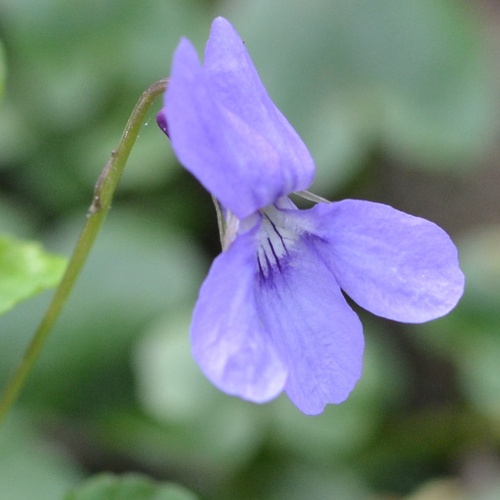
Early Dog-violet
Viola reichenbachiana
An elegant purple herald of the spring equinox, the Early Dog-violet thrives in the dappled shade of ancient woods. Its dark, solid spur and heart-shaped leaves make it a favorite for woodland explorers and early-season pollinators.
Quick Identification
Size
Height of 5–15 cm (2–6 inches) with a leaf spread of up to 20 cm (8 inches)
Colors
Pale purple to lilac petals with dark violet veins on the lower petal; characterized by a solid, dark purple spur at the rear
Key Features
- Dark purple, unnotched spur at the back of the flower
- Narrow lilac petals that typically do not overlap
- Heart-shaped, hairless leaves with slightly scalloped edges
- Blooms early in spring, often weeks before other violet species
When You’ll See Them
Geographic range
Where Does the Early Dog-violet Live?
The Early Dog-violet is primarily native to the continent of Europe, with its range extending into parts of Western Asia and the Mediterranean fringes of North Africa. It is most frequently encountered across the United Kingdom, France, and Central Europe, where it serves as an indicator species for long-established, ancient woodland habitats. While it is stable within its native European core, it is rarely found as an introduced species in the Americas or Australia.
Basemap © OpenStreetMap contributors
Behavior
The Early Dog-violet is a perennial harbinger of spring, emerging from a creeping rhizome to carpet woodland floors before the leaf canopy closes. Unlike its cousin, the Sweet Violet, this species is entirely scentless. The name "dog-violet" was historically given to distinguish it from the fragrant varieties, suggesting it was of lower value or "fit only for dogs."
The plant employs a dual-flowering strategy to ensure survival. In early spring, it produces the familiar purple flowers designed for cross-pollination by bees and butterflies. Later in the season, it develops "cleistogamous" flowers—small, bud-like blooms that never open and instead self-pollinate under the cover of the leaves. Once the seeds are ripe, they are often dispersed by ants, which carry the seeds to their nests to eat a fatty attachment known as an elaiosome.
EverydayEarth exclusive
Camera Tips
Capturing the Early Dog-violet on a backyard or trail camera requires a shift in perspective. Since these plants are low to the ground, you should mount your camera on a ground spike or a very low tripod, positioned only 4 to 6 inches above the soil. Standard trail cameras often have a fixed focus designed for larger animals at a distance, so check if your model has a macro lens attachment or a close-focus setting (usually around 30-50cm) to ensure the delicate veins on the petals remain sharp.
To capture the most dynamic "behavior" of this plant, use a time-lapse mode rather than motion triggering. Set the camera to take a photo every 15 to 30 minutes during the daylight hours in late March or April. This will allow you to see the flowers "bow" and rise in response to the sun and moisture. If you are lucky, you might also trigger motion captures of visiting pollinators like the Bee-fly (Bombylius major) or early brimstone butterflies that rely on these flowers for nectar.
Lighting is critical for wildflowers. Avoid placing the camera where it will face the direct, harsh noon sun, as this will wash out the subtle lavender colors. Instead, look for "dappled light" under a deciduous tree canopy, which mimics the plant's natural environment and provides a much more professional, soft-focus aesthetic. If you are monitoring the plant later in the season, keep the camera in place to witness the explosive seed pods; when the seeds are ready, the pods dry and contract, eventually shooting the seeds several feet away from the parent plant.
Similar Species
Species that look similar or are commonly confused with Early Dog-violet.
Frequently Asked Questions
Record Early Dog-violet at your habitat
Connect a camera to start building your own species record — AI identifies every visitor automatically.