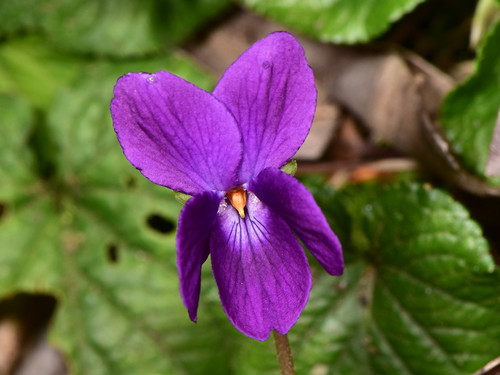
Sweet violet
Viola odorata
The Sweet violet is the quintessential herald of spring, blanketing garden floors with deep purple blooms and an unforgettable fragrance. A favorite of poets and pollinators alike, this hardy perennial turns any shaded corner into a miniature woodland sanctuary.
Quick Identification
Size
Height: 10–15 cm (4–6 in); Spread: 20–60 cm (8–24 in) via stolons
Colors
Deep violet-purple, occasionally white or pale rose; dark green foliage
Key Features
- Heart-shaped leaves with finely serrated margins
- Five-petaled flowers with a distinct, sweet scent
- Creeping growth habit using above-ground runners (stolons)
- Hooked flower stalks that droop toward the ground
When You’ll See Them
Behavior
Sweet violets are hardy perennials that announce the arrival of spring, often blooming while the air is still crisp. Unlike many other wildflowers, they spread aggressively through stolons—creeping stems that take root at intervals to create a lush, green carpet. This makes them a favorite for gardeners looking for a fragrant groundcover that can handle the dappled shade of a backyard woodland.
While they are celebrated for their iconic scent, this fragrance is fleeting to the human nose due to ionone, a compound that temporarily desensitizes our sense of smell. In the wild, these plants provide an essential early-season nectar source for emerging bees and butterflies. They also have a unique relationship with ants; their seeds have a fleshy attachment called an elaiosome, which encourages ants to carry the seeds back to their nests, effectively planting the next generation of violets.
EverydayEarth exclusive
Camera Tips
To capture the beauty of Sweet violet with an AI-powered camera, you need to think low. Because these plants rarely exceed six inches in height, mount your camera on a ground-stake or a very low tripod. Aim for a 45-degree downward angle or a completely horizontal side profile to capture the 'nodding' habit of the flower heads. If your camera has a macro lens or a close-focusing mode, this is the perfect time to use it, as the intricate veins on the petals are a key identification feature.
While the plant itself is stationary, it is a hub for early-season insect activity. Position your camera near a dense patch of blooms on a sunny spring morning. Use a high-trigger speed or set your camera to 'Time-Lapse' mode with intervals of 5-10 minutes. This will allow you to capture the flowers opening with the sun and document the various pollinators, such as mason bees or early butterflies, that visit the nectar-rich blooms.
For the best lighting, avoid the harsh midday sun which can wash out the deep purple hues. Early morning or 'golden hour' late in the afternoon provides a soft, warm light that makes the violet colors pop. If your camera supports it, adjust the exposure compensation slightly downward to keep the rich purples from appearing overexposed. In the summer months, keep the camera in place to capture the development of 'cleistogamous' flowers—self-pollinating buds that never open but produce the bulk of the plant's seeds near the soil surface.
Similar Species
Species that look similar or are commonly confused with Sweet violet.
Frequently Asked Questions
Record Sweet violet at your habitat
Connect a camera to start building your own species record — AI identifies every visitor automatically.