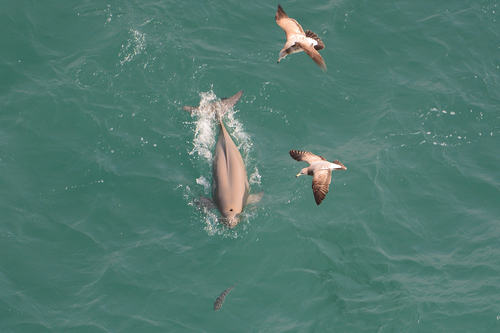
East Asian finless porpoise
Neophocaena sunameri
Meet the 'smiling' phantom of the East Asian coast. This dorsal-finless wonder is a master of the shallows, weaving through the estuaries of Japan and China with grace and intelligence.
Quick Identification
Size
Length: 1.5 to 2.2 meters (4.9 to 7.2 feet); Weight: 30 to 72 kg (66 to 159 lbs)
Colors
Uniformly light gray or sandy gray; newborns are typically darker/black, lightening as they mature.
Key Features
- Complete lack of a dorsal fin, replaced by a low skin ridge
- Blunt, rounded head with no protruding beak
- Small, stocky body with a pale gray underside
- Small, spade-shaped teeth unlike the conical teeth of dolphins
When You’ll See Them
Geographic range
Where Does the East Asian finless porpoise Live?
The East Asian finless porpoise is native to the temperate and subtropical coastal waters of the western Pacific Ocean. Its core range includes the East China Sea, the Yellow Sea, and the coastal waters surrounding the Japanese archipelago. This species stays close to the shoreline, hugging the coasts of China, South Korea, North Korea, and Japan, rarely venturing far into the open ocean.
Basemap © OpenStreetMap contributors
Behavior
The East Asian finless porpoise is an elusive and somewhat shy marine mammal. Unlike many dolphin species, they are not known for acrobatic leaps or 'bow-riding' alongside boats. Instead, they tend to stay close to the surface with a subtle rolling motion, making them difficult to spot in anything but calm waters. They are often found alone or in small pods of two to four individuals, though they may congregate in larger numbers in areas with high prey density.
These porpoises rely heavily on high-frequency echolocation to navigate the often-murky coastal waters of East Asia. They are highly intelligent and show a high degree of site fidelity, often returning to the same bays and estuaries year after year. While they generally avoid human contact, they are frequently found in close proximity to coastal communities due to their preference for shallow, productive waters where fishing and shipping activity is also high.
EverydayEarth exclusive
Camera Tips
Capturing the East Asian finless porpoise on camera requires a specialized setup because they rarely leave the water. For those with coastal property or access to piers, an underwater camera housing or a high-quality action camera with a 'time-lapse' or 'motion detection' setting (specifically for underwater movement) is essential. Mount the camera to a submerged structure like a pier piling or a weighted tripod at a depth of 2–3 meters, angling it slightly upward to capture the porpoise's silhouette against the surface light.
Because these animals do not respond to traditional bait, you must place your camera in 'bottleneck' locations. Look for narrow channels between sandbars or the mouths of estuaries where the porpoises are likely to pass during the incoming tide while hunting. If you have a private dock, installing a submersible green or white light can be a game-changer; the light attracts small fish and shrimp, which in turn draws the porpoises into the camera's field of view at night.
Use a camera with a fast trigger speed or set your device to record in continuous loops. Porpoises move quickly, and their roll at the surface lasts only a second. If your camera has a 'pre-roll' feature, enable it to ensure you catch the animal before it moves out of frame. During the winter months, water clarity often improves in the Yellow Sea and around Japan, providing the best conditions for clear, high-definition captures of their unique, smiling facial expressions.
Similar Species
Species that look similar or are commonly confused with East Asian finless porpoise.
Frequently Asked Questions
Record East Asian finless porpoise at your habitat
Connect a camera to start building your own species record — AI identifies every visitor automatically.