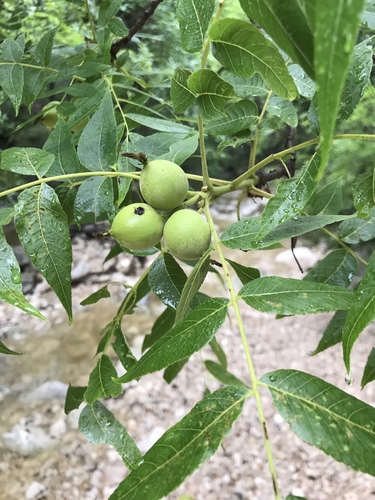
eastern black walnut
Juglans nigra
The Eastern Black Walnut is a titan of the North American forest, prized for its dark, rot-resistant wood and rich, oily nuts. A keystone of backyard ecology, it serves as a bustling cafeteria for squirrels and a high-rise nesting site for songbirds.
Quick Identification
Size
Typically 21–30 m (70–100 ft) tall with a trunk diameter of 0.6–1.2 m (2–4 ft); record specimens reach 45 m (150 ft).
Colors
Dark brown to nearly black deeply furrowed bark; bright yellow-green pinnate foliage; lime-green spherical fruit husks.
Key Features
- Deeply furrowed bark with a distinct diamond-shaped pattern
- Large pinnate compound leaves with 15-23 leaflets
- Spherical green fruit that stains skin and surfaces black
- Distinctive 'chambered' pith inside broken twigs
When You’ll See Them
Geographic range
Where Does the eastern black walnut Live?
The Eastern Black Walnut is a quintessentially North American species, native to the central and eastern portions of the continent. Its territory stretches from southern Ontario and the Great Lakes region down to the Gulf Coast, and from the Atlantic seaboard westward to the Great Plains. While it has been introduced to Europe and South America for its prized timber and edible nuts, its most ecologically significant presence remains in the fertile river valleys of the American Midwest and the Appalachian foothills.
Basemap © OpenStreetMap contributors
Behavior
The Eastern Black Walnut is a 'pioneer' species that thrives in full sun and is famous for its allelopathic nature. It produces a chemical called juglone from its roots, leaves, and husks, which acts as a natural herbicide. This 'chemical warfare' prevents many other plants, such as tomatoes, apples, and birches, from growing within its root zone, effectively reducing competition for resources.
As a mast-fruiting species, its reproductive behavior is cyclical. Every few years, a 'mast year' occurs where the tree produces an overwhelming abundance of nuts, far more than local wildlife can consume. This strategy ensures that even after squirrels and rodents have had their fill, enough nuts remain to sprout new seedlings. In the years between, nut production is much lower to keep seed-predator populations in check.
EverydayEarth exclusive
Camera Tips
Capturing the Eastern Black Walnut on camera is less about the tree's movement and more about the hub of activity it creates. To photograph the wildlife it attracts, mount your camera directly to the trunk about 5 to 6 feet up, angled slightly downward toward the base of the tree. This is where squirrels, chipmunks, and even wild turkeys will gather in the fall to forage for fallen nuts. Because these trees are tall and have high canopies, a second camera placed 20 feet back with a wide-angle view can capture the 'squirrel highway'—the acrobatic movements of rodents navigating the branches.
For those using AI-powered cameras, set your trigger sensitivity to high during September and October. This is when the nuts fall, and the activity level peaks. Black Walnuts are a favorite of Fox Squirrels and Grey Squirrels; you can capture fascinating 'caching' behavior as they bury nuts for the winter. To get the best shots of the tree itself, focus on the bark texture during the 'golden hour'—the hour before sunset—when the low-angled light emphasizes the deep, diamond-patterned furrows of the trunk.
In late spring, the Eastern Black Walnut is one of the last trees to leaf out, which provides a unique window for birdwatching. Mount your camera with a view of the upper branches to catch migratory songbirds like Baltimore Orioles or Great Crested Flycatchers, which prefer the open structure of the walnut's canopy before it becomes fully shaded. Use a fast shutter speed (at least 1/500s) to freeze the motion of birds and quick-moving squirrels against the bright green foliage.
Similar Species
Species that look similar or are commonly confused with eastern black walnut.
Butternut
Also known as White Walnut, it has elongated oval nuts and its twigs have a 'fuzzy' fringe above the leaf scars.
Tree of Heaven
An invasive look-alike with similar compound leaves, but its leaflets have small glands at the base and its bark resembles cantaloupe skin rather than deep furrows.
Frequently Asked Questions
Record eastern black walnut at your habitat
Connect a camera to start building your own species record — AI identifies every visitor automatically.