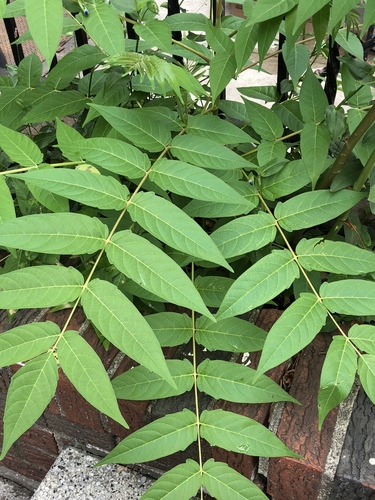
tree-of-heaven
Ailanthus altissima
Often called the 'ghetto palm' for its resilience in urban environments, the tree-of-heaven is a lightning-fast grower with a hidden, aggressive side. While its tropical appearance is striking, it is a master of chemical warfare in the plant world.
Quick Identification
Size
Height: 15–25 m (50–80 ft); Trunk diameter: up to 1 m (3.3 ft)
Colors
Light grey bark; dark green leaves; seeds (samaras) are pale green, turning vibrant orange-red in late summer
Key Features
- Large pinnately compound leaves (1-4 feet long)
- Glandular teeth or 'notches' at the base of each leaflet
- Smooth, light grey bark that develops a cantaloupe-like texture with age
- Strong, unpleasant odor described as 'burnt peanut butter' when leaves are crushed
When You’ll See Them
Behavior
Tree-of-heaven is an exceptionally fast-growing deciduous tree known for its aggressive colonization of disturbed areas. It is a pioneer species that thrives where other plants struggle, often sprouting through cracks in pavement or in poor, compacted urban soils. Its growth strategy is dual-pronged: it produces hundreds of thousands of wind-dispersed seeds annually and also spreads vigorously through an underground network of clonal root suckers.
One of the tree's most notable 'behaviors' is its allelopathic nature. It produces a chemical called ailanthone in its roots and bark that leaches into the soil, effectively poisoning and inhibiting the growth of neighboring plant species. This allows the tree to create dense monocultures, quickly outcompeting native vegetation. In North America and Europe, it has become a significant ecological concern, particularly as the primary host plant for the invasive Spotted Lanternfly.
EverydayEarth exclusive
Camera Tips
While a tree might seem like a static subject, the tree-of-heaven is a hub of activity for backyard wildlife and invasive species monitoring. To capture the best footage, focus your camera on the trunk rather than the canopy. This is the best way to document the presence of the Spotted Lanternfly, which crawls up the trunk in large numbers. Mount your camera at chest height (about 4-5 feet), aimed slightly downward to capture the texture of the bark and any insects or small mammals moving along the base.
For those interested in the tree's incredible growth rate, utilize a time-lapse setting. Set your camera to take one photo every 24 hours from the same fixed position starting in early spring. By mid-summer, you will have a fascinating sequence showing the rapid 'reach' of its compound leaves. Because the leaflets are quite large and move easily in the wind, ensure your motion trigger sensitivity is set to 'Medium' to avoid hundreds of 'false' triggers caused by a light breeze.
Lighting plays a critical role in distinguishing tree-of-heaven from its look-alikes on camera. The bark is relatively reflective; midday sun can wash out the subtle fissures that characterize the species. For the most 'identifiable' shots, position your camera so it faces North or South to take advantage of side-lighting during the morning and evening. This will highlight the 'cantaloupe skin' texture of the mature bark and the vibrant, winged seeds (samaras) which are a key identification feature in late summer and autumn.
Similar Species
Species that look similar or are commonly confused with tree-of-heaven.
Frequently Asked Questions
Record tree-of-heaven at your habitat
Connect a camera to start building your own species record — AI identifies every visitor automatically.