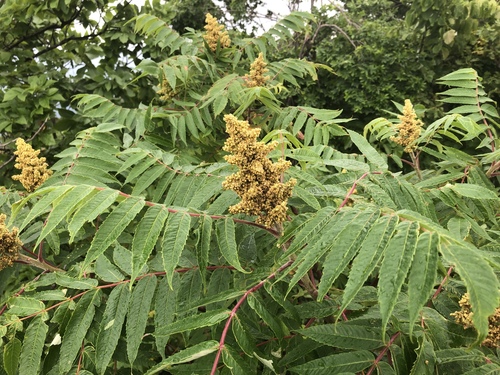
staghorn sumac
Rhus typhina
Famous for its velvet-textured branches and cone-shaped crimson fruit, the staghorn sumac is a stunning native shrub that serves as a winter lifeline for backyard birds.
Quick Identification
Size
15-30 feet (4.5-9 meters) tall with a similar spread; trunk diameter 2-6 inches (5-15 cm).
Colors
Deep green serrated leaves turning brilliant scarlet and orange in fall; rust-red fuzzy fruit clusters; brownish-gray velvety stems.
Key Features
- Velvety hair-covered branches resembling deer antlers
- Pyramidal clusters of fuzzy red fruits that persist through winter
- Large pinnate leaves with 11-31 pointed leaflets
- Milky white sap that oozes from broken stems
When You’ll See Them
Behavior
Staghorn sumac is a resilient, colony-forming shrub that acts as a vital pioneer species in North American landscapes. It spreads primarily through an underground rhizome system, creating dense thickets that provide essential nesting cover for songbirds and hiding spots for small mammals. While it grows aggressively in open, sunny areas, it is relatively short-lived for a woody plant, often giving way to larger forest trees over several decades.
Ecologically, the staghorn sumac is a powerhouse for biodiversity. In the spring, its greenish-yellow flower spikes provide nectar for a wide array of native bees and butterflies. As the seasons turn, the plant produces its iconic crimson fruit bobs. While these fruits are low in fat, they are high in vitamin C and persist throughout the winter, serving as a critical 'emergency' food source for birds when more calorie-dense berries have been depleted.
EverydayEarth exclusive
Camera Tips
Staghorn sumac is one of the best natural 'props' you can use for backyard wildlife photography. To capture the most variety, mount your AI-powered camera at a height of 5-6 feet, aiming directly at a cluster of mature red fruit bobs. During the late winter months, these clusters become a hub of activity for over-wintering birds like Northern Cardinals, American Robins, and Eastern Bluebirds. The bright red of the fruit provides a stunning color contrast, especially in snowy conditions, making for high-quality, 'National Geographic' style captures.
If you are looking to record mammals, try placing a camera near the base of a sumac thicket. The dense structure of the colony provides a safe corridor for Cottontail Rabbits, Chipmunks, and even Wild Turkeys. Use a wide-angle setting to capture the movement within the shadows of the large leaves. Because sumac often grows on slopes or embankments, ensure your camera is level to the ground rather than the trunk to avoid skewed perspectives in your videos.
Lighting is key when dealing with the unique textures of the staghorn sumac. If possible, position your camera so the morning sun hits the fuzzy 'antler' branches from the side. This backlighting or side-lighting highlights the fine hairs on the stems, creating a beautiful halo effect that adds a professional touch to your wildlife clips. In the autumn, the fiery red leaves can sometimes trigger 'overexposure' on auto-settings; if your camera allows it, slightly turn down the exposure compensation to keep the deep reds from looking 'blown out' in direct sunlight.
For those using motion-activated cameras, be mindful of the sumac's large, heavy leaves. On windy days, the swaying foliage can cause 'false triggers.' To solve this, use the EverydayEarth app to set a specific 'activity zone' focused strictly on the fruit clusters or the main trunk, ignoring the peripheral leaves. This ensures your SD card is filled with visiting birds and mammals rather than hours of wind-blown branches.
Similar Species
Species that look similar or are commonly confused with staghorn sumac.
Smooth Sumac
Almost identical but lacks the velvety hairs on the stems and has a more glaucous, waxy coating.
Poison Sumac
Has white, hanging berry clusters and hairless stems, unlike the upright red fuzzy fruits of the staghorn sumac.
Tree of Heaven
An invasive look-alike with a notched base on each leaflet and foul-smelling crushed leaves; lacks the red fuzzy 'bobs.'
Frequently Asked Questions
Record staghorn sumac at your habitat
Connect a camera to start building your own species record — AI identifies every visitor automatically.