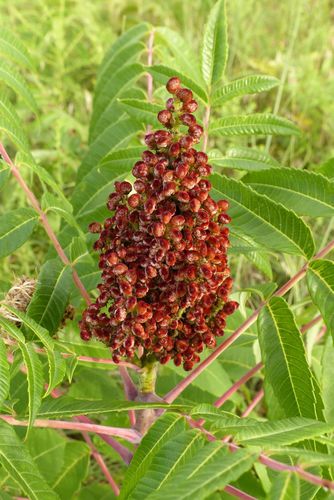
smooth sumac
Rhus glabra
A champion of the autumn landscape, the smooth sumac offers more than just brilliant red foliage; it is a vital winter pantry for North American wildlife. From pollinators in the spring to foraging birds in the winter, this hardy shrub is a buzzing center of backyard activity.
Quick Identification
Size
9–15 feet (2.7–4.5 meters) in height and spread; occasionally reaching 20 feet (6 meters) in optimal conditions.
Colors
Blue-green waxy stems; dark green leaves with pale undersides; greenish-yellow flowers; deep crimson-red fuzzy berry clusters; brilliant scarlet to orange autumn foliage.
Key Features
- Smooth hairless stems with a waxy blue-gray bloom
- Pinnately compound leaves with 11–31 serrated leaflets
- Upright pyramidal clusters of velvety red fruit
- Milky white sap produced when stems or leaves are broken
- Spreading colony-forming growth habit via underground rhizomes
When You’ll See Them
Behavior
Smooth sumac is a resilient, colony-forming shrub that plays a vital role as a pioneer species in North American ecosystems. It is the only shrub native to all 48 lower U.S. states, frequently appearing in disturbed areas, old fields, and along forest edges. It spreads primarily through underground runners, creating dense thickets that serve as essential protective cover for small mammals and nesting sites for songbirds. During the summer, its large clusters of tiny flowers provide a high-volume nectar source for a vast array of native bees, butterflies, and beetles.
Ecologically, the smooth sumac is most famous for its persistence. While many plants wither in the winter, the sumac’s red fruit clusters, known as 'bobs,' remain on the plant through the coldest months. Because these berries are high in vitamin C but low in fat, they are often ignored by wildlife during the autumn 'bounty' and saved as an emergency food source for late winter. This makes the plant a critical survival resource for overwintering birds like bluebirds and robins during periods of heavy snow cover.
EverydayEarth exclusive
Camera Tips
Smooth sumac is a fantastic 'anchor' for backyard trail cameras because it functions as a multi-season wildlife hub. To capture the greatest variety of species, position your camera 3 to 4 feet off the ground and 6 to 10 feet away from a mature fruit cluster. During the winter, these red drupes are a magnet for birds like Northern Flickers, Eastern Bluebirds, and Wild Turkeys. Setting your camera at a slight downward angle toward the berry clusters will provide intimate, eye-level footage of these birds as they pick at the fruit when other food sources are buried under snow.
Don't just focus on the fruit; the base of a sumac thicket is a high-traffic highway for mammals. The dense, arching stems provide a 'safe zone' for rabbits, opossums, and foxes. Place a second camera at a low height (12–18 inches) near the edge of the thicket to capture these animals as they move in and out of cover. If you are targeting deer, look for 'rub' marks on the smooth bark, as the supple stems are a favorite for bucks in the late summer and early fall. Setting your camera to a 3-shot burst mode is ideal for capturing the fast movements of birds fluttering among the leaves.
Seasonal transitions offer the best visual rewards. In the autumn, the foliage turns a stunning, high-contrast scarlet that makes for a professional-looking backdrop for any wildlife passing through. If your camera has a time-lapse function, consider setting it to take a photo every few hours from September through October to document the dramatic color shift. Be mindful of exposure settings; the bright red berries can sometimes cause 'clipping' in direct midday sun, so choosing a spot with dappled light or facing your camera North will ensure the colors remain true and detailed.
Similar Species
Species that look similar or are commonly confused with smooth sumac.
Frequently Asked Questions
Record smooth sumac at your habitat
Connect a camera to start building your own species record — AI identifies every visitor automatically.