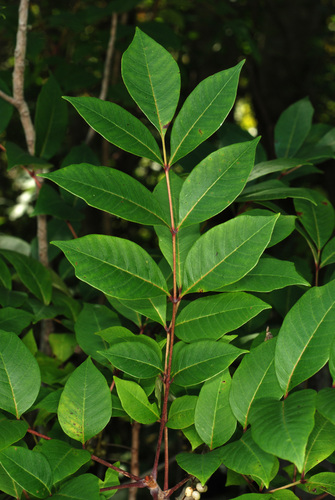
poison sumac
Toxicodendron vernix
Avoid the itch and discover the striking beauty of one of nature's most misunderstood wetland residents. Poison Sumac offers a masterclass in 'look but don't touch' with its brilliant autumn colors and distinctive white berries.
Quick Identification
Size
Typically 2-6 meters (6-20 feet) tall, occasionally reaching 9 meters (30 feet) with a spread of 2-4 meters.
Colors
Bright green summer foliage; vibrant orange, fire-engine red, and deep purple in autumn; creamy white to grayish-white berries; reddish leaf stems.
Key Features
- Compound leaves with 7-13 leaflets
- Leaflet margins are smooth and toothless (entire)
- Clusters of white or gray berries that hang downward
- Reddish tint on the leaf stems (petioles) and new growth
When You’ll See Them
Behavior
The plant follows a strictly seasonal growth cycle, leafing out in late spring with bright green foliage. In early summer, it produces inconspicuous yellowish-green flower panicles that eventually develop into the signature drooping white berries. As temperatures drop in the fall, poison sumac becomes a standout in the landscape, turning brilliant shades of orange and red long before many other deciduous trees.
While highly irritating to humans, the plant is a vital resource for local wildlife. Species like the gray catbird and various woodpeckers rely on the berries as a high-energy winter food source. The plant's primary defense is chemical, and its oils remain active on dead wood and fallen leaves for years, requiring extreme caution from hikers and photographers in every season.
EverydayEarth exclusive
Camera Tips
Capturing high-quality imagery of poison sumac requires a blend of macro photography techniques and extreme safety precautions. Because the plant produces urushiol—an oil that causes severe allergic reactions—you should never handle the plant or place your camera where it might brush against the leaves without wearing thick, disposable nitrile gloves. If your camera setup involves a tripod, ensure the legs are wiped down with a degreasing soap or a specialized urushiol cleanser after the shoot to prevent transferring the oil to your hands or car later.
To get the best identification shots, set your camera to focus on the leaf margins and the berry clusters. Poison sumac is best identified by its smooth leaf edges and white, hanging drupes (berries). Using a camera with a macro lens or a high-resolution sensor will allow you to zoom in on the leaf attachment points, which often have a distinctive reddish tint. Avoid shooting in the direct, harsh midday sun, which can wash out the subtle greens and whites; instead, aim for the 'golden hour' shortly before sunset when the low-angle light highlights the waxy texture of the berries and the smoothness of the stems.
Since plants do not trigger standard PIR (Passive Infrared) motion sensors on trail cameras, you'll need to use specific settings to document them. To record its growth or the beautiful transition from summer green to autumn crimson, use your camera’s time-lapse mode. Setting the camera to take one photo every 4 to 6 hours over the course of September and October will provide a stunning visual record of its color change. If you are using a standard trail camera to watch for birds feeding on the berries, place the camera approximately 3-5 feet from the plant and set the motion sensitivity to 'high' to catch small songbirds like chickadees or catbirds.
Consider the background when positioning your camera. Because poison sumac often grows in dense, swampy thickets, the background can be cluttered and distracting. Position your lens so there is a gap in the foliage behind the plant, or use a wider aperture to blur the background, making the pinnate leaves and pale berries pop. If you are documenting the plant in winter, look for the gray-white berries against the snow; the high contrast provides an excellent opportunity for 'white on white' photography that emphasizes the plant's structural silhouette and identifies it even when the leaves are gone.
Similar Species
Species that look similar or are commonly confused with poison sumac.
Frequently Asked Questions
Record poison sumac at your habitat
Connect a camera to start building your own species record — AI identifies every visitor automatically.