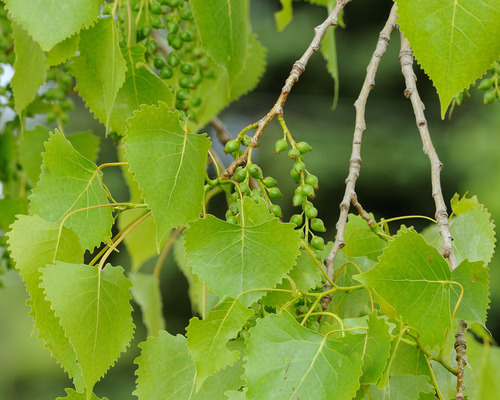
Eastern Cottonwood
Populus deltoides
An icon of the American riverbank, the Eastern Cottonwood is a towering giant famous for its shimmering leaves and the summer 'snow' of its fluffy seeds.
Quick Identification
Size
Height: 20–40 m (65–130 ft); Trunk Diameter: 1.2–1.8 m (4–6 ft)
Colors
Ash-gray bark with deep furrows; bright green leaves with silvery undersides; yellow fall foliage
Key Features
- Broadly triangular (deltoid) leaves with curved teeth
- Flat petioles that allow leaves to shake in the wind
- Deeply fissured, thick gray bark on mature trunks
- Large, sticky, resinous buds in winter
When You’ll See Them
Geographic range
Where Does the Eastern Cottonwood Live?
The Eastern Cottonwood is native to the vast landscapes of North America, stretching across nearly the entire eastern and central United States. Its range extends north into the southern Canadian prairies and parts of Quebec and Ontario, and southward into the northeastern regions of Mexico. While it is most concentrated in the Mississippi River basin, it has been widely planted as a shade tree in suburban areas across the continent.
Basemap © OpenStreetMap contributors
Behavior
The Eastern Cottonwood is a fast-growing pioneer species, often the first to colonize open, wet areas like riverbanks and floodplains. It is known for its remarkable growth rate, sometimes adding several feet in height per year, and its ability to withstand temporary flooding. Its most famous 'behavior' occurs in early summer when female trees release millions of seeds attached to fluffy, white cotton-like fibers, creating a snow-like effect across the landscape.
Because of its size and tendency to develop hollows as it ages, this tree serves as a vital ecological anchor. It provides massive amounts of shade and wind protection. In human-dominated landscapes, it is valued for quick shade, though its brittle wood means it frequently sheds branches during storms, which in turn creates ground-level habitat for insects and small mammals.
EverydayEarth exclusive
Camera Tips
When using an AI-powered camera with an Eastern Cottonwood, think of the tree as a skyscraper for wildlife. To capture the most activity, mount your camera directly onto the trunk facing a sturdy horizontal limb about 15–20 feet up. This is a prime highway for squirrels, raccoons, and even opossums. Use a wide-angle setting to capture the movement of birds like orioles and woodpeckers that favor the high canopy.
In late spring, aim your camera toward the ground at the base of the tree with a high shutter speed. This is the best way to capture the 'cotton fall'—the blizzard of seeds that characterizes this species. The white fibers can sometimes trick motion sensors, so you may need to adjust your sensitivity settings to avoid thousands of empty triggers during a windy day.
Because these trees are often located near water, the base of a Cottonwood is a natural 'scent station' for local mammals. Placing a camera 2 feet off the ground facing the trunk can reveal how deer, foxes, and coyotes use the tree as a marking post. During the winter, the large, resinous buds are a favorite snack for various bird species; a close-focus camera setup near lower branches can provide stunning macro-style shots of winter foraging.
Similar Species
Species that look similar or are commonly confused with Eastern Cottonwood.
Quaking Aspen
Aspens have smoother, whiter bark and smaller, rounder leaves compared to the deeply furrowed bark of mature cottonwoods.
Black Willow
Willows share the same wet habitats but have long, narrow, lance-shaped leaves rather than the broad triangular leaves of the cottonwood.
Bigtooth Aspen
Bigtooth leaves have much larger, blunt teeth and the bark lacks the deep, rugged furrows found on older cottonwood trunks.
Frequently Asked Questions
Record Eastern Cottonwood at your habitat
Connect a camera to start building your own species record — AI identifies every visitor automatically.