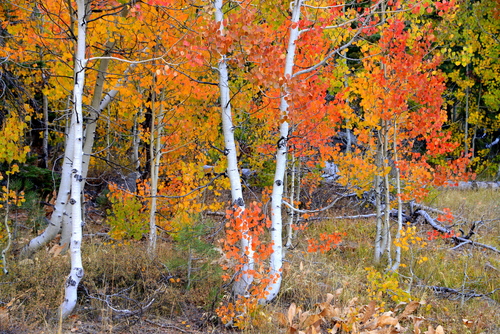
quaking aspen
Populus tremuloides
Known for their shimmering leaves and striking white bark, the Quaking Aspen is more than just a tree—it's a living, breathing colony that defines the North American wilderness.
Quick Identification
Size
Height up to 25 meters (82 feet); trunk diameter usually 10–60 cm (4–24 inches)
Colors
Smooth white to greenish-white bark with horizontal black scars; heart-shaped green leaves turning bright gold or yellow in autumn
Key Features
- Flattened leaf stalks (petioles) that cause leaves to tremble in the breeze
- Smooth, pale bark that does not peel like birch
- Grows in large, uniform 'clonal' groves sharing one root system
- Heart-shaped leaves with finely saw-toothed edges
When You’ll See Them
Behavior
The Quaking Aspen is famous for its unique 'trembling' leaves, a result of flattened petioles that catch the wind and cause a shimmering effect. Beyond its individual beauty, the Aspen is one of the most social organisms on Earth; a single grove often consists of 'clones' that share a massive, interconnected root system. One such colony in Utah, named Pando, is considered one of the oldest and heaviest living organisms on the planet.
These trees are considered 'pioneer species,' meaning they are often the first to grow back in areas cleared by fire or logging. They provide essential services to the ecosystem, offering shade to diverse undergrowth and serving as a primary food source for a variety of North American wildlife, from elk to ruffed grouse.
EverydayEarth exclusive
Camera Tips
Capturing the Quaking Aspen on camera is less about catching a fleeting moment and more about documenting a seasonal story. Because their leaves are almost always in motion, use a fast shutter speed if you want crisp, still images. However, to capture the 'quaking' effect that gives the tree its name, video mode is essential. Set your AI-powered camera to trigger during the windiest parts of the day or use a time-lapse mode to see the shimmering canopy in action.
For a unique perspective, place your camera at the base of the trunk looking straight up. This 'worm's eye view' emphasizes the height of the white trunks against a blue sky or the brilliant gold of autumn foliage. If you are using an EverydayEarth camera to track wildlife, Aspens are a natural magnet. Deer and elk frequently rub their antlers against the bark, and bears often leave claw marks as they climb. Aim your camera at eye-level on a nearby tree to catch these animal interactions.
Time-lapse is your best friend when it comes to Aspens. Because these trees change so dramatically, setting a camera to take one photo every day from the same spot can create a stunning sequence of the leaves budding in spring, turning deep green in summer, and exploding into gold in the fall. Make sure the camera is securely mounted on a post or another stable tree to prevent shifting over the months.
Lastly, pay attention to the bark. The white bark of the Aspen is actually photosynthetic, meaning it stays 'alive' even in winter. During the snowy months, the contrast between the white trunk and a snowy background can be difficult for some sensors to handle. Adjust your exposure settings slightly higher (+0.5 or +1.0) if your camera allows, to ensure the white bark doesn't appear grey or dull in your winter trail cam footage.
Similar Species
Species that look similar or are commonly confused with quaking aspen.
Frequently Asked Questions
Record quaking aspen at your habitat
Connect a camera to start building your own species record — AI identifies every visitor automatically.