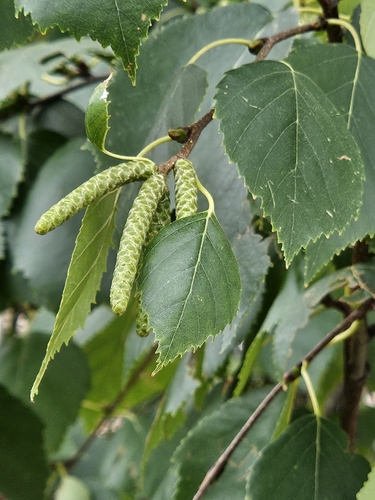
paper birch
Betula papyrifera
The ghost of the northern woods, the paper birch is famous for its striking white, peeling bark. It acts as a vital sanctuary and food source for a massive variety of birds and mammals.
Quick Identification
Size
Typically reaches 15–21 meters (50–70 feet) in height with a trunk diameter of 30–60 centimeters (1–2 feet).
Colors
Creamy bright white bark with dark horizontal lines; underside of bark is salmon-pink or orange; foliage turns brilliant gold in fall.
Key Features
- Bright white bark that peels in thin, papery horizontal layers
- Small, dark, horizontal slit-like pores called lenticels
- Ovate or heart-shaped leaves with sharply double-toothed edges
- Distinctive drooping male catkins appearing in early spring
When You’ll See Them
Behavior
The paper birch is a classic 'pioneer species,' meaning it is often the first tree to reclaim open land after a fire, landslide, or timber harvest. It grows quickly to take advantage of full sunlight, acting as a protective canopy for slower-growing hardwoods like maples and oaks. In the wild, it is a short-lived but vital species that adds significant vertical structure and food resources to the forest ecosystem.
Beyond its growth habits, the paper birch is a high-traffic hub for backyard biodiversity. Its bark is rich in betulin, a waxy substance that makes the tree highly resistant to water and rot—a trait historically used by Indigenous peoples to build lightweight canoes. For local wildlife, the tree serves as a communal pantry, offering sap to insects and birds, and nutrient-dense twigs to wintering mammals.
EverydayEarth exclusive
Camera Tips
When using an AI camera to monitor a paper birch, the biggest challenge is the 'white-out' effect. The bright, chalky white bark is highly reflective. If you point your camera directly at the trunk in midday sun, the exposure will likely blow out, making it impossible to see visiting birds or squirrels. Instead, mount your camera 10–15 feet away at a 45-degree angle. This use of side-lighting preserves the texture of the peeling bark and creates a high-contrast backdrop that makes the dark silhouettes of animals like woodpeckers or nuthatches really pop.
For capturing avian visitors, focus your camera on the mid-section of the trunk where the bark is most textured. Species like the Yellow-bellied Sapsucker drill 'sap wells' in paper birches; if you find these rows of small holes, aim your camera specifically at that spot. Use a high-sensitivity trigger setting or a short interval time-lapse mode, as birds tend to move quickly across the bark. If you are mounting the camera on the birch itself to look downward at the base, use a rubber strap rather than a nail to protect the sensitive living tissue beneath the thin bark.
Winter is arguably the best time to monitor your paper birch with a trail camera. The lack of leaves provides a clear line of sight, and many animals, including deer and moose, will approach the tree to browse on the nutrient-rich twigs. However, be careful with nighttime settings. Standard infrared (IR) flashes can bounce off the white bark and create a blinding glare. If your camera has 'No-Glow' or 'Black Flash' technology, use it. This will prevent the light from reflecting too harshly, allowing you to see the fine details of a nocturnal flying squirrel or an owl perched in the white branches.
Similar Species
Species that look similar or are commonly confused with paper birch.
Gray Birch
Gray birch bark is off-white, does not peel in layers, and has distinct dark triangular patches where branches meet the trunk.
Quaking Aspen
Aspen bark is smoother and does not peel; its leaves are more circular and have flattened stems that cause them to 'quake' in the wind.
Yellow Birch
Yellow birch has bronze or golden bark that peels in much tighter, thinner curls and smells faintly of wintergreen when a twig is broken.
Frequently Asked Questions
Record paper birch at your habitat
Connect a camera to start building your own species record — AI identifies every visitor automatically.