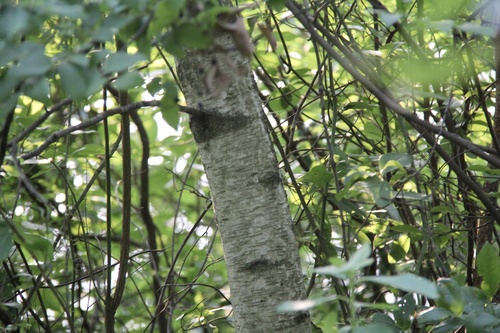
gray birch
Betula populifolia
A striking pioneer of the northern forest, the gray birch is easily recognized by its chalky white bark and distinctive triangular leaves. It serves as a vital 'nursery tree,' providing a fast-growing sanctuary for backyard birds and butterflies.
Quick Identification
Size
20–30 feet (6–9 meters) tall; trunk diameter of 4–8 inches (10–20 cm)
Colors
Chalky white to grayish-white bark; dark, triangular patches at the base of branches; vibrant green leaves turning golden yellow in fall
Key Features
- Triangular leaves with long, tapered tips and doubly-serrated edges
- Chalky white bark that does not peel easily like other birches
- Prominent dark, triangular 'chevron' markings where branches meet the trunk
- Often grows in multi-stemmed clumps rather than a single trunk
When You’ll See Them
Behavior
The gray birch is a resilient 'pioneer species,' often being the first tree to colonize land after a fire, logging, or clear-cutting. Because it grows quickly and thrives in full sunlight, it acts as a nursery tree, providing shade and protection for slower-growing hardwoods like oaks and maples that eventually take over the forest canopy. While individual trees are relatively short-lived compared to other birches—often reaching only 30 to 50 years—they play a vital role in the ecosystem by stabilizing soil and providing immediate habitat.
In a backyard setting, gray birches are highly interactive with local wildlife. Their flexible, slender branches often bend under the weight of winter ice or heavy snow, sometimes touching the ground without breaking. They are particularly social in an ecological sense, hosting a wide variety of larvae for butterflies and moths, which in turn attracts insectivorous birds. Unlike the paper birch, the gray birch is more tolerant of poor, dry soils, making it a common sight in suburban developments and disturbed edge habitats.
EverydayEarth exclusive
Camera Tips
When setting up a backyard camera to capture the gray birch, think of the tree as a stage rather than just a subject. Because the bark is a bright, chalky white, it can easily 'blow out' or appear overexposed in direct midday sun. To get the best detail in the bark's texture and those iconic black chevron markings, position your camera to face north or south to avoid direct glare, or utilize the soft, diffused light of early morning and late afternoon. If your AI camera features a time-lapse mode, the gray birch is an ideal candidate; its rapid leaf-out in spring and brilliant yellow transformation in autumn provide stunning visual narratives of the changing seasons.
To capture the wildlife that frequents this species, mount your camera approximately 5 to 7 feet high on a neighboring structure or tree, angled slightly downward toward the main trunk or a sturdy lower limb. Gray birches are magnets for Yellow-bellied Sapsuckers, which drill neat rows of small holes to drink the sap. Setting your camera to a high-sensitivity motion trigger near these sap wells will reward you with footage of not just woodpeckers, but also hummingbirds and insects that come to steal a sweet drink. In the winter, the seeds from the birch's catkins attract flocks of Common Redpolls and American Goldfinches, so ensure your frame includes the dangling seed pods at the branch tips.
For those interested in nocturnal visitors, the gray birch is a favorite rubbing post for White-tailed Deer due to its flexible trunk and textured bark. Position a trail camera at 'deer eye level' (about 3 to 4 feet) facing a young birch in a clearing. If you are using an infrared flash, be aware that the white bark is highly reflective; you may need to reduce the flash intensity in your settings or move the camera a few feet further back to prevent the tree from appearing as a glowing white blur in your night shots.
Similar Species
Species that look similar or are commonly confused with gray birch.
Paper Birch
Paper birch bark peels in large, curling sheets and the leaves are more oval-shaped compared to the long-pointed, triangular leaves of the gray birch.
Quaking Aspen
Aspen bark is smooth and greenish-white without the dark branch chevrons; their leaves are rounded rather than triangular and 'quake' or tremble in the slightest breeze.
Frequently Asked Questions
Record gray birch at your habitat
Connect a camera to start building your own species record — AI identifies every visitor automatically.