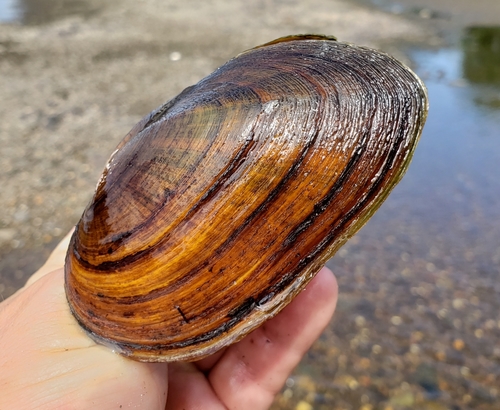
Eastern Elliptio
Elliptio complanata
The quiet guardian of our waterways, the Eastern Elliptio is North America's most common freshwater mussel. Its beautiful purple interior hides a powerful filtration system that keeps our rivers and lakes clean and clear.
Quick Identification
Size
5 to 13 cm (2 to 5.1 inches) in length
Colors
Dark brown to blackish exterior shell; interior shell (nacre) is famously purple or lilac, occasionally white or pink
Key Features
- Elliptical to trapezoidal shell shape
- Deep purple or iridescent lilac interior lining
- Dark, cloth-like outer skin (periostracum)
- Prominent, concentric growth rings on the shell surface
- Heavier and thicker shell compared to many pond mussels
When You’ll See Them
Geographic range
Where Does the Eastern Elliptio Live?
This resilient bivalve is native to the eastern half of North America, spanning from the Canadian provinces of Ontario and Quebec down through the eastern United States to Georgia. It is remarkably widespread within the Atlantic slope drainages and the Saint Lawrence River basin, often becoming the dominant mussel species in terms of sheer biomass. Because of its adaptability, it remains a common sight in both pristine mountain streams and more developed suburban waterways across its core range.
Basemap © OpenStreetMap contributors
Behavior
While they may appear as inanimate as river stones, these mussels are capable of slow movement using a muscular 'foot' that they extend into the sand or gravel. They use this foot to anchor themselves against currents or to reposition if water levels drop. Their life cycle is remarkably complex, relying on a 'hitchhiking' stage where their larvae, known as glochidia, attach to the gills of a host fish—most commonly the American Eel—to be transported to new areas of the watershed.
EverydayEarth exclusive
Camera Tips
Set your camera to macro mode or focus manually on the 'siphon'—the small, fringed opening where the mussel draws in water. This is the most dynamic part of the animal. If your camera has a time-lapse feature, this is the best way to record them. A 4-hour time-lapse with a photo taken every 30 seconds can reveal the mussel slowly 'crawling' across the substrate or reacting to changes in light and water flow, movements that are otherwise imperceptible to the naked eye.
Lighting is crucial for underwater shots. In murky water, use an off-camera light source at a 45-degree angle to minimize backscatter from floating debris. The best footage is usually captured in the late summer when water levels are low and clarity is at its peak. Be sure to check the camera's seals and battery life before submersion, as cold water can drain batteries significantly faster than air. If you find a 'mussel bed' with dozens of individuals, position the camera to capture a wide field of view to see the collective movement of siphons closing and opening.
Similar Species
Species that look similar or are commonly confused with Eastern Elliptio.
Frequently Asked Questions
Record Eastern Elliptio at your habitat
Connect a camera to start building your own species record — AI identifies every visitor automatically.