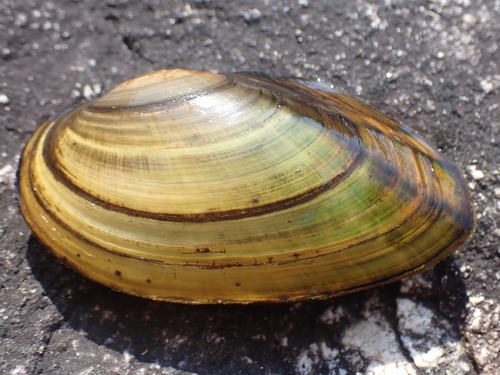
Eastern Floater
Pyganodon cataracta
The Eastern Floater is the unsung hero of our waterways, a master filter-feeder that cleans our ponds while moving silently through the shadows of the silt.
Quick Identification
Size
Shell length typically ranges from 10 to 15 cm (4 to 6 inches), with large specimens reaching up to 20 cm (8 inches); weight is negligible as the shell is remarkably thin.
Colors
Shell is usually yellowish-green to dark forest green, often with fine green rays; the interior (nacre) is a shimmering silvery-white or bluish-white.
Key Features
- Thin, fragile elliptical shell
- Complete absence of hinge teeth
- Prominent double-loop sculpture on the beak (umbo)
- Smooth, polished shell surface
When You’ll See Them
Geographic range
Where Does the Eastern Floater Live?
Native to the eastern regions of North America, the Eastern Floater is a widespread resident of Atlantic slope drainages. Its territory stretches from the lower Saint Lawrence River basin in Canada down through the eastern United States, reaching as far south as the Gulf drainages in Florida and Alabama. Because of its high tolerance for varied water conditions, it is one of the most common freshwater mussels found in both wild wetlands and suburban park ponds.
Basemap © OpenStreetMap contributors
Behavior
The Eastern Floater is a quiet but vital engineer of freshwater ecosystems. Unlike many other mussels that require high-oxygen, fast-moving water, the Eastern Floater is named for its ability to survive in 'slack water' like ponds and silty lakes where other species might suffocate. It spends most of its life partially buried in the substrate, using its muscular 'foot' to anchor itself or move slowly across the bottom in search of optimal feeding positions.
As a filter feeder, it plays a massive role in water purification. A single mussel can filter gallons of water per day, removing algae, bacteria, and organic detritus. While they appear stationary, they are highly sensitive to vibrations and changes in light, snapping their shells shut at the first sign of a predator like a muskrat or an otter. Their reproduction is a fascinating display of biological trickery; they release larvae called glochidia that must briefly attach to the fins or gills of a host fish, such as a sunfish or perch, to hitchhike to new locations before dropping off to begin their adult life.
EverydayEarth exclusive
Camera Tips
Capturing an Eastern Floater on camera requires an underwater approach, as these bivalves are rarely seen above the waterline unless the water level has dropped significantly. The best setup is a waterproof action camera, like a GoPro, mounted on a small, weighted tripod or a flat lead plate. Place the camera in shallow water (6-12 inches deep) near the edge of a pond or slow stream where you see 'tracks' in the silt—long, winding grooves that indicate a mussel has been moving.
Because mussels move very slowly, traditional motion-triggering may not work. Instead, use the 'Time Lapse' mode on your camera. Set the interval to one photo every 30 to 60 seconds. When you play these back as a video, you will see the 'stationary' mussel surprisingly active, inching through the mud and extending its fleshy siphons to breathe and eat. This reveals a side of their life that is invisible to the naked eye.
Clarity is your biggest challenge. To prevent the camera from being obscured by kicked-up silt, place it 'upstream' of the mussel if there is a slight current, or set it gently on a flat rock rather than directly in the mud. For the best lighting, record during the middle of the day when the sun can penetrate the water column, but avoid high-glare situations by choosing a spot with some overhanging vegetation or using a polarizing filter if your camera housing allows it.
Keep an eye out for 'midden heaps'—piles of empty shells on the bank left by raccoons or muskrats. If you find a fresh pile, it's a sign that live Eastern Floaters are nearby. Setting a trail camera on the bank overlooking these shell piles can also help you capture the predators that hunt these mussels, providing a complete picture of your backyard's aquatic food web.
Similar Species
Species that look similar or are commonly confused with Eastern Floater.
Alewife Floater
Very similar but has a more swollen shell and typically requires the Alewife fish as a host for reproduction.
Giant Floater
Generally larger and found further west; it has slightly different 'beak sculpture' patterns on the top of the shell.
Paper Pondshell
Even thinner-shelled and more elongated, usually found in extremely quiet, stagnant waters.
Frequently Asked Questions
Record Eastern Floater at your habitat
Connect a camera to start building your own species record — AI identifies every visitor automatically.