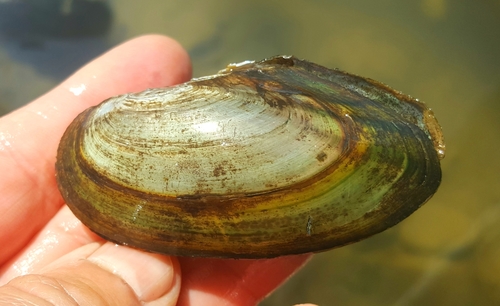
Paper Pondshell
Utterbackia imbecillis
The Paper Pondshell is the translucent treasure of the freshwater world. With a shell so thin it earned the nickname 'Paper Floater,' this delicate mollusk serves as a silent, shimmering guardian of our pond health.
Quick Identification
Size
3 to 6 inches (7.6 to 15.2 cm) in length; extremely lightweight with a shell thickness often less than 1mm.
Colors
Exterior is typically yellowish-green to forest green with dark green rays; the interior (nacre) is a brilliant silvery-white or bluish-white.
Key Features
- Extremely thin, fragile shell that can be crushed with light pressure
- Oblong, elliptical shape with a nearly straight hinge line
- Complete lack of 'teeth' (pseudocardinal or lateral) inside the hinge
- Smooth, glossy surface often marked with fine green radiating lines
When You’ll See Them
Behavior
The Paper Pondshell is a sedentary filter feeder that lives partially buried in the soft substrate of freshwater environments. Unlike many other mussels that require specific fish hosts to complete their life cycle, the Paper Pondshell is remarkably adaptable; it is often hermaphroditic and can even develop larvae (glochidia) without a host in some conditions. This allows it to colonize new or isolated ponds much faster than other unionid species.
While they may appear motionless, they use a muscular 'foot' to slowly plow through mud or sand, leaving distinct trails behind them. They are sensitive indicators of water quality, as they constantly pump water through their systems to breathe and eat. In high-quality habitats, they may congregate in 'beds,' though they are generally solitary compared to more social aquatic species.
Interaction with humans is usually limited to beachcombers finding their 'floater' shells. The name 'Paper Floater' comes from the fact that their shells are so thin and light that once the animal dies and the shell dries out, it can actually float on the water's surface or be easily tossed by the slightest breeze along a shoreline.
EverydayEarth exclusive
Camera Tips
To capture the Paper Pondshell on camera, you will need to move your gear underwater. Use an action camera with a waterproof housing or a dedicated underwater trail camera. Placement is key: look for shallow, sun-drenched margins of ponds where the bottom is composed of silt or fine sand. Position the camera on a weighted base or a low-profile tripod about 6-12 inches from a specimen that is partially buried. Look for two small openings in the silt—the siphons—which are the clearest sign of a living mussel.
Because mussels move at a literal snail's pace, standard motion-trigger settings are often ineffective. Instead, use the 'Time-Lapse' mode on your camera. Setting the camera to take a photo every 30 to 60 seconds over a four-hour period will allow you to compress their slow movements into a fascinating video. You may see the shell slowly rocking as it burrows deeper or the siphons pulsing as they filter the water.
Lighting is your best friend and worst enemy underwater. Aim for mid-morning or early afternoon when the sun is high to penetrate the water column. Avoid stirring up the mud when you place the camera, as the resulting 'cloud' can take hours to settle and will ruin your clarity. If the water is particularly murky, try placing a small, white plastic card in the background to help the camera’s auto-focus lock onto the green shell of the Pondshell.
In the autumn or during dry spells, keep an eye on receding shorelines. This is a great time to use a standard backyard camera on a 'macro' or close-focus setting to capture the intricate ray patterns on the shells left behind by receding waters. While these shells are inanimate, they provide high-contrast subjects that look stunning in the golden hour light, revealing the 'paper-thin' nature of their construction.
Similar Species
Species that look similar or are commonly confused with Paper Pondshell.
Frequently Asked Questions
Record Paper Pondshell at your habitat
Connect a camera to start building your own species record — AI identifies every visitor automatically.