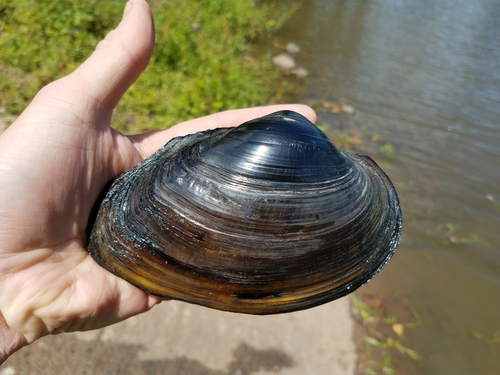
Giant Floater
Pyganodon grandis
The unsung hero of the pond, the Giant Floater is a master of filtration that keeps our waterways healthy. This large, delicate mussel is a fascinating example of the hidden life thriving beneath the surface of your local lake.
Quick Identification
Size
Typically 10-20 cm (4-8 inches) in length; shell thickness is notably thin compared to other river mussels.
Colors
Exterior ranges from yellowish-green to dark brown or black, often with subtle green rays; the inner shell (nacre) is silvery-white, bluish, or occasionally pinkish.
Key Features
- Large, elliptical, and very thin-walled shell
- Complete lack of 'hinge teeth' on the interior of the shell
- Prominent, inflated beak (umbo) that rises significantly above the hinge line
- Lightweight shell that feels surprisingly fragile for its size
When You’ll See Them
Behavior
The Giant Floater is a quiet but vital engineer of freshwater ecosystems. Unlike many other mussel species that require fast-flowing, oxygen-rich gravel beds, the Giant Floater is highly adaptable, often thriving in the silty or muddy bottoms of ponds, lakes, and sluggish streams. They spend the majority of their lives partially buried in the substrate, using a muscular 'foot' to anchor themselves or to move slowly across the bottom in search of better conditions.
As filter feeders, they act as living water purifiers. By drawing water in through an incurrent siphon, they strain out microscopic algae, bacteria, and organic detritus, which they use for food. A single mussel can filter several gallons of water a day, significantly improving water clarity. Their reproductive cycle is uniquely complex, involving a 'hitchhiking' stage where their larvae, called glochidia, must attach to the fins or gills of a host fish—such as a Bluegill or Largemouth Bass—to develop before dropping off to begin their independent life on the lake floor.
EverydayEarth exclusive
Camera Tips
Capturing a Giant Floater on camera requires a different approach than typical backyard wildlife. Since they are aquatic, the best results come from using a waterproof action camera (like a GoPro) mounted on a weighted base or a small tripod submerged in shallow water (1-3 feet deep). Look for 'siphon holes' or the slightly parted edges of a shell in sandy or muddy areas near the shore. Position the camera at a low angle, nearly level with the substrate, to capture the delicate movement of the siphons as they pump water.
Time-lapse mode is your best friend for this species. While they may appear stationary, a time-lapse taken over 2-4 hours will reveal their surprisingly active nature, showing them pivoting in the mud or slowly 'walking' through the silt. Ensure your camera is set to a high frame rate and use a polarizing filter if shooting from above the water to cut through surface glare and reflections.
Lighting is crucial in murky pond environments. If the water is cloudy, try to film on bright, sunny days when natural light can penetrate to the bottom. Avoid disturbing the silt when placing your camera, as the resulting cloud can take hours to settle. You don't need bait for these creatures, but placing the camera near a known fish 'nesting' area can sometimes capture the fascinating moment when the mussel releases its larvae to find a host fish.
Similar Species
Species that look similar or are commonly confused with Giant Floater.
Frequently Asked Questions
Record Giant Floater at your habitat
Connect a camera to start building your own species record — AI identifies every visitor automatically.