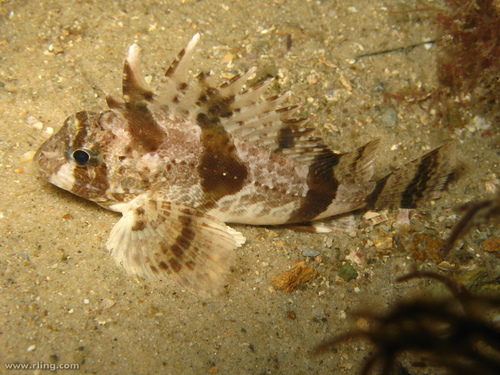
Eastern Fortescue
Centropogon australis
A hidden gem of the Australian coastline, the Eastern Fortescue is a tiny titan of camouflage. Equipped with venomous spines and a spectacular mottled pattern, it thrives in the quiet corners of our eastern estuaries.
Quick Identification
Size
Small fish reaching up to 15 cm (6 inches) in length.
Colors
Mottled pattern of cream, tan, and reddish-brown with several distinct dark brown to black vertical bands across the body.
Key Features
- 16 sharp venomous dorsal spines
- Deeply notched dorsal fin
- Mottled camouflage pattern
- Large, fan-like pectoral fins used for 'walking' on the seabed
When You’ll See Them
Geographic range
Where Does the Eastern Fortescue Live?
Native to the Oceania region, the Eastern Fortescue is an Australian endemic species found exclusively along the temperate and subtropical eastern coastline. Its range spans from the southern waters of Queensland near Moreton Bay, extending south through the entirety of the New South Wales coast, and reaching into the eastern corner of Victoria. It is a highly localized resident of sheltered bays and estuaries, frequently appearing in the tidal waterways of major coastal cities like Sydney and Brisbane.
Basemap © OpenStreetMap contributors
Behavior
The Eastern Fortescue is a master of camouflage, spending much of its life resting motionless on the sea floor. As a member of the waspfish family, it relies on its cryptic coloration to blend seamlessly into seagrass, rubble, or muddy substrates. This sedentary lifestyle serves a dual purpose: it hides the fish from larger predators like Flathead or Herons and allows it to remain undetected by the small shrimp and crustaceans it preys upon.
Despite its small size, this species is well-defended. When threatened, it flares its dorsal spines, which are equipped with venom glands. While not aggressive, it is famous among Australian fishers and beachcombers for the 'fortie' sting—a sharp, painful puncture that occurs when the fish is accidentally stepped on or handled. In a backyard estuary or tidal creek, they are fascinating to watch as they occasionally 'hop' or 'walk' across the bottom using their specialized pelvic fins.
EverydayEarth exclusive
Camera Tips
Capturing the Eastern Fortescue requires a specialized underwater camera setup, specifically one rated for saltwater environments. If your property borders a tidal creek, salt marsh, or canal, place your camera directly on the substrate during low tide (if accessible) or lower it into the water near structure. Target the edges of seagrass beds or the base of jetty pylons, as Fortescues rarely swim in open water, preferring to stay within inches of the bottom where they can blend in.
Because these fish are often motionless for hours, standard motion-detecting AI might struggle to trigger. To overcome this, use a camera with a 'time-lapse' mode or one specifically tuned for underwater silhouettes. If you are using an AI-powered camera, ensure the lens is positioned horizontally across a clear patch of sand adjacent to seagrass. The movement of the fish as it 'hops' or 'walks' to a new hiding spot is the most likely time for a successful capture.
Visibility can be an issue in estuarine 'backyard' settings due to silt. To get the clearest footage, place your camera in an area with some water flow but away from direct mud-stirring currents. Using a small mesh bag filled with crushed prawns as bait can attract the shrimp and small fish that the Fortescue eats, eventually luring the predator itself into the frame. Be sure to clean the lens regularly, as salt spray and biofouling can quickly obscure the view in coastal environments.
Similar Species
Species that look similar or are commonly confused with Eastern Fortescue.
Frequently Asked Questions
Record Eastern Fortescue at your habitat
Connect a camera to start building your own species record — AI identifies every visitor automatically.