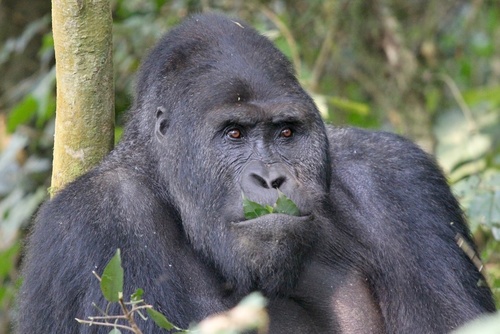
Eastern Gorilla
Gorilla beringei
The Eastern Gorilla is the world's largest living primate, a gentle giant reigning over the misty forests of Central Africa. These powerful yet peaceful apes live in tight-knit families led by magnificent silverbacks.
Quick Identification
Size
Height: 1.5 to 1.9 m (4.9 to 6.2 ft); Weight: 70 to 205 kg (154 to 452 lbs)
Colors
Deep black fur; mature males develop a prominent silver-grey 'saddle' across their back; skin is uniformly black.
Key Features
- Massive, muscular build with a broad chest and heavy neck
- Distinctive silver saddle on mature adult males (Silverbacks)
- Large head with a prominent brow ridge and small, flat ears
- Long, powerful arms and relatively short, thick hair
When You’ll See Them
Geographic range
Where Does the Eastern Gorilla Live?
The Eastern Gorilla is native to the heart of the African continent, specifically within the Albertine Rift montane forests and the lowland basins of Central Africa. Its core range is strictly limited to the Democratic Republic of the Congo, Rwanda, and Uganda, spanning isolated pockets of high-altitude and lowland habitat. These majestic primates are confined to these shrinking forest islands, with no introduced populations elsewhere in the world.
Basemap © OpenStreetMap contributors
Behavior
Eastern Gorillas are highly social primates that live in stable, cohesive groups led by a dominant male known as a silverback. These groups, often consisting of several females and their offspring, spend the majority of their day foraging through the forest and resting. They are remarkably peaceful giants, using a complex range of vocalizations, chest-beating displays, and facial expressions to communicate and maintain order within the troop.
Daily life involves a cycle of feeding, traveling, and social bonding, which includes significant time for grooming and play among juveniles. At night, they construct elaborate nests from branches and leaves, either on the ground or in trees, for a safe night's sleep. While they are primarily terrestrial, their strength allows them to climb trees to reach succulent fruit or find a secure resting spot when needed.
Interactions with humans are generally rare and limited to protected national parks. In areas where ecotourism is active, some groups have been 'habituated' to human presence over many years, allowing for close-range observation. However, they remain wild animals and will defend their troop vigorously if the silverback perceives a threat to his family.
EverydayEarth exclusive
Camera Tips
Capturing the Eastern Gorilla on camera requires strategic placement along known foraging trails or near clearings with abundant bamboo or wild celery. Because these primates are incredibly strong and naturally curious, it is vital to secure your camera in a heavy-duty security box (often called a 'bear box') and mount it to a thick, sturdy tree. Position the camera at about 3 to 4 feet off the ground—gorillas are primarily terrestrial, and a lower angle provides a more intimate, eye-level perspective of their facial expressions and social interactions.
Since gorillas live in dense, often dimly lit forest canopies, use a camera with a high-quality sensor and fast trigger speed (0.3 seconds or less). Motion blur is a common issue under the canopy, so prioritize cameras with adjustable shutter speeds or dedicated 'fast' night modes. Avoid using white flash at all costs, as this will startle the troop and may cause the silverback to perceive the camera as a threat; invisible 'no-glow' infrared LEDs are essential for discreet observation.
Gorillas are highly intelligent and may notice changes in their environment. Using scent-elimination spray on the camera housing can prevent curious juveniles from licking or touching the lens, which is a common reason for obscured footage. Check the camera during the driest parts of the day when gorillas are less likely to be moving through to minimize disturbance.
Always ensure you are working within legal conservation frameworks and have the necessary permits when placing equipment in their protected habitats. Because Eastern Gorillas are critically endangered, minimizing human scent and presence is not just about getting a good shot—it's about protecting the health of the troop from human-borne illnesses.
Similar Species
Species that look similar or are commonly confused with Eastern Gorilla.
Frequently Asked Questions
Record Eastern Gorilla at your habitat
Connect a camera to start building your own species record — AI identifies every visitor automatically.