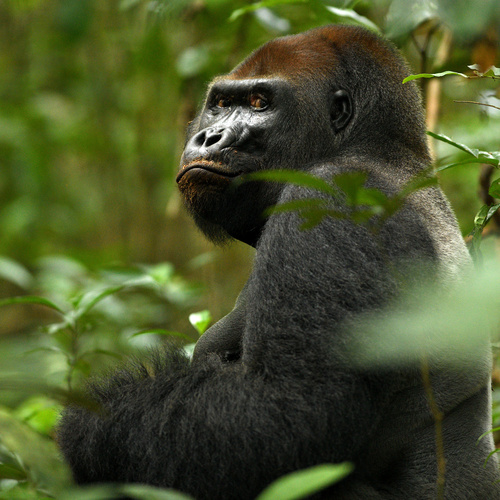
Western Gorilla
Gorilla gorilla
The Western Gorilla is a symbol of the African rainforest’s untamed majesty, known for its incredible strength and complex social bonds. As the more numerous of the two gorilla species, these gentle giants play a vital role as 'gardeners of the forest' by dispersing seeds across their vast tropical territories.
Quick Identification
Size
Males 1.5-1.8m (4.9-5.9 ft) tall, 140-270 kg (310-600 lbs); Females 1.2-1.5m (3.9-4.9 ft) tall, 60-100 kg (130-220 lbs)
Colors
Brownish-grey to blackish-brown fur; mature males (silverbacks) develop a distinctive silver-white saddle on their backs and thighs.
Key Features
- Prominent brow ridge and small ears
- Broad chest and muscular build
- Nostrils shaped like two distinct 'wings'
- Adult males have silver hair on back
- Knuckle-walking quadrupedal stance
When You’ll See Them
Geographic range
Where Does the Western Gorilla Live?
Native to the dense, humid rainforests of West-Central Africa, the Western Gorilla calls the lush Congo Basin home. Its primary range spans across Gabon, Cameroon, and the Republic of the Congo, stretching into parts of the Central African Republic, Equatorial Guinea, and a small enclave in Angola. While they are lowland specialists, they thrive in diverse terrains ranging from swampy marshes to secondary forests where fruit remains abundant throughout the seasons.
Basemap © OpenStreetMap contributors
Behavior
Western Gorillas are highly social primates that live in cohesive family groups known as troops, typically led by a single dominant silverback male. These groups usually consist of several adult females and their offspring. Unlike the more aggressive portrayals in popular media, they are generally peaceful and shy creatures, spending most of their day foraging for food and resting in communal nests built on the ground or in trees.
Their social structure is fluid, with both males and females often dispersing from their birth groups to join new ones or form their own. Communication is complex, involving a wide range of vocalizations, facial expressions, and body postures. While they are primarily terrestrial, they are skilled climbers, especially when lured by ripening fruit in the canopy.
Interactions with humans are historically cautious, but habitat encroachment has brought them into closer proximity with forest-dwelling communities. They are essential to their ecosystem as seed dispersers, often referred to as the 'gardeners of the forest' because of their nomadic foraging habits that spread plant life across vast distances.
EverydayEarth exclusive
Camera Tips
Capturing Western Gorillas on camera requires a strategic approach focused on their daily travel routes and high-energy food sources. Position your camera approximately 3 to 4 feet off the ground, as these primates are primarily knuckle-walkers; a chest-level angle for a silverback provides the most majestic profile shots. Aim the lens toward 'baïs' (forest clearings) or near fruiting trees like Uapaca or Dialium, which serve as natural magnets for troops during the dry season.
Because gorillas are highly intelligent and naturally curious, use a secure, bear-proof housing or a very discreet mounting system. They may investigate or even dismantle a camera if it stands out or emits a visible 'red glow' during night recording. Opt for 'No-Glow' or black infrared LEDs to ensure your equipment remains undetected during their early morning or late evening movements.
Set your camera to take rapid-fire bursts or short video clips (15-20 seconds). Gorillas often move in a single-file line behind the silverback; a single photo might capture the leader, but a video or burst mode will capture the entire family unit, including playful juveniles and mothers carrying infants. High-speed triggers are essential, as their movement through dense undergrowth can be surprisingly quick.
Lastly, consider the tropical environment. Use high-quality lithium batteries and include desiccant packets inside the camera housing to combat the extreme humidity of the African rainforest. Check your equipment during the mid-day rest period (roughly 12 PM to 2 PM) when the troop is least likely to be on the move, minimizing potential disturbances to their natural routine.
Similar Species
Species that look similar or are commonly confused with Western Gorilla.
Frequently Asked Questions
Record Western Gorilla at your habitat
Connect a camera to start building your own species record — AI identifies every visitor automatically.