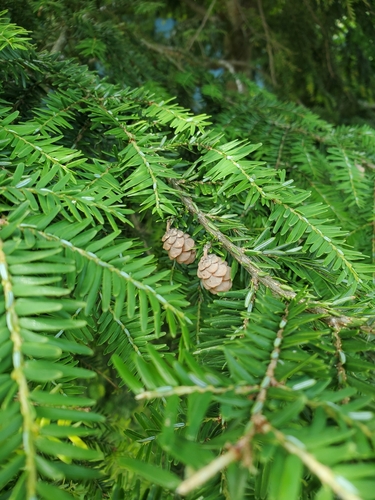
eastern hemlock
Tsuga canadensis
Known as the 'Redwood of the East,' the Eastern Hemlock is a graceful, long-lived conifer that creates cool, shaded sanctuaries for countless wildlife species. Its delicate, lacy foliage and small cones make it a cornerstone of the Appalachian forest.
Quick Identification
Size
Height: 18–30 m (60–100 ft); Trunk diameter: 0.6–1.5 m (2–5 ft)
Colors
Lustrous dark green needles with two silvery-white stripes underneath; bark is cinnamon-red to grayish-brown
Key Features
- Short, flat needles with rounded tips
- Two distinct white bands on needle undersides
- Small, oval woody cones 1.3 to 2.5 cm long
- Graceful, drooping terminal leading shoot
When You’ll See Them
Geographic range
Where Does the eastern hemlock Live?
This majestic conifer is native to the eastern half of North America, stretching from the maritime provinces of Canada down through the Great Lakes region and along the rugged Appalachian Mountains into northern Georgia and Alabama. It thrives in the humid, temperate forests of the United States and Canada, where it serves as a staple of the northern hardwood forest. While primarily wild, it has been successfully introduced as an ornamental species in the United Kingdom and parts of mainland Europe, where it is prized for its graceful, weeping form.
Basemap © OpenStreetMap contributors
Behavior
The Eastern Hemlock is a "foundation species," meaning it creates a unique ecosystem beneath its dense canopy. Unlike many evergreens, it is exceptionally shade-tolerant, often spending decades in the forest understory waiting for a gap in the canopy to grow. Its presence significantly cools the surrounding air and nearby streams, providing essential microclimates for aquatic life and forest floor dwellers.
While it doesn't "behave" in the animal sense, it interacts with humans as a beloved ornamental and a cornerstone of Appalachian forests. It is one of the longest-lived trees in eastern North America, with some specimens reaching over 800 years of age. Unfortunately, it currently faces a massive threat from the Hemlock Woolly Adelgid, an invasive insect that has devastated populations in the southern part of its range.
EverydayEarth exclusive
Camera Tips
Capturing the Eastern Hemlock on camera is less about the tree moving and more about the incredible wildlife it attracts. To get the best shots, position your camera at a medium height (4-6 feet) pointed toward the lower branches or the base of the trunk. Hemlocks are a magnet for biodiversity; you’ll likely capture Black-throated Green Warblers in the canopy or Red-backed Salamanders in the cool, damp needles at the base. If you have an AI camera, focus the lens on a "clearance" area under the dense needles where animals often seek shelter from rain or snow.
Because hemlocks create deep shade, lighting can be a challenge. Ensure your camera is set to a high-sensitivity (ISO) mode or use a model with high-quality infrared night vision. The dark green foliage provides a beautiful, high-contrast backdrop for lighter-colored animals like White-tailed Deer or Barred Owls. If you are monitoring the health of the tree itself, use a macro lens or a close-focus setting to look for the white, cottony masses of the Hemlock Woolly Adelgid on the underside of the twigs.
In winter, the Eastern Hemlock becomes a focal point for wildlife photography. Its dense needles catch snow, creating a picturesque winter wonderland, but more importantly, they provide thermal cover for mammals. Setting up a camera near a hemlock grove during a snowstorm is a surefire way to see how local wildlife uses these trees for protection. No bait is usually needed, but a nearby water source like a stream—which hemlocks often shade—will increase your chances of seeing elusive species like Fishers or Bobcats.
Similar Species
Species that look similar or are commonly confused with eastern hemlock.
Frequently Asked Questions
Record eastern hemlock at your habitat
Connect a camera to start building your own species record — AI identifies every visitor automatically.