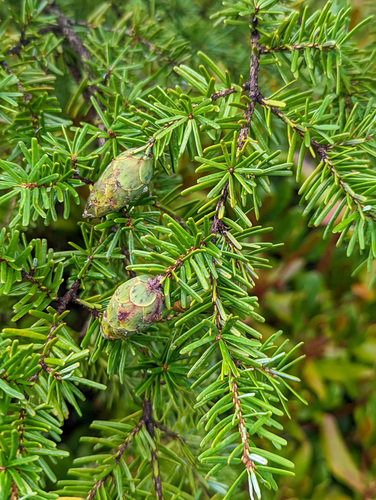
Carolina hemlock
Tsuga caroliniana
A rare and rugged gem of the southern Appalachians, the Carolina hemlock stands as a resilient sentinel on rocky mountain ridges. With its distinctive star-like needle pattern and graceful drooping branches, this iconic conifer offers a glimpse into a unique and ancient mountain ecosystem.
Quick Identification
Size
A medium-sized evergreen reaching 15–30 meters (50–100 feet) in height with a trunk diameter of 0.6–1.5 meters (2–5 feet).
Colors
Glossy dark green needles with two silvery-white bands on the underside; bark is dark reddish-brown to grayish-purple.
Key Features
- Needles radiate in all directions around the twig like a bottlebrush
- Cones are 2.5–3.5 cm long with thin scales that spread wide when mature
- Pyramidal crown with graceful, slightly drooping branches
- Bark is deeply furrowed and scaly on older specimens
When You’ll See Them
Geographic range
Where Does the Carolina hemlock Live?
Native exclusively to the southeastern United States, the Carolina hemlock is a rare endemic species of the southern Appalachian Mountains. Its highly restricted range follows the mountain spine through parts of Virginia, North Carolina, South Carolina, Tennessee, and Georgia. It is most commonly found in the Blue Ridge Mountains, where it clings to rugged, high-elevation terrain.
Basemap © OpenStreetMap contributors
Behavior
The Carolina hemlock is a slow-growing, long-lived conifer that plays a vital role in its high-elevation ecosystem. Unlike many other evergreens, it is remarkably well-adapted to rugged, rocky terrain where soil is thin and nutrients are scarce. It often grows as a solitary sentinel or in small, scattered groves rather than forming the dense, dark forests typical of its cousin, the Eastern hemlock.
Ecologically, this tree acts as a crucial anchor for mountain biodiversity. Its dense evergreen canopy provides essential winter thermal cover for various bird species and small mammals. It also serves as a host for a variety of specialized insects, though it is currently facing a significant threat from the hemlock woolly adelgid, an invasive sap-sucking insect that has caused widespread decline across its limited range.
EverydayEarth exclusive
Camera Tips
When monitoring a Carolina hemlock with a backyard or trail camera, the tree itself becomes the stage for a variety of mountain wildlife. To capture the best images, position your camera on a nearby sturdy tree or post about 4 to 5 feet off the ground, angled slightly upward to frame the lower branches. This positioning is ideal for spotting Nuthatches, Chickadees, and Blue-headed Vireos that frequently forage among the needles for insects.
Because these trees often grow on steep or rocky slopes, ensure your camera mount is highly adjustable. Focus your lens on the branch tips, especially during late summer and autumn when the cones are maturing. This is the best time to record the activity of squirrels and crossbills as they work to extract seeds from the cones. Using a high-resolution photo mode or 4K video is recommended to capture the fine details of the star-like needle arrangement and the presence of the invasive hemlock woolly adelgid.
During the winter months, the Carolina hemlock provides a rare splash of green in a dormant landscape, making it a magnet for wildlife seeking shelter. Consider setting your camera to a shorter trigger interval during snowstorms, as many birds and small mammals will huddle within the dense branches for protection. If you are specifically monitoring the health of the tree, macro-focus settings can help you document the white, cottony egg sacs of the woolly adelgid on the underside of the needles.
Similar Species
Species that look similar or are commonly confused with Carolina hemlock.
Eastern Hemlock
Eastern hemlock needles are arranged in two flat rows along the twig, whereas Carolina hemlock needles radiate in all directions.
Catawba Rhododendron
While both share the same rocky mountain habitat, the Rhododendron has large, broad leathery leaves rather than short evergreen needles.
Frequently Asked Questions
Record Carolina hemlock at your habitat
Connect a camera to start building your own species record — AI identifies every visitor automatically.