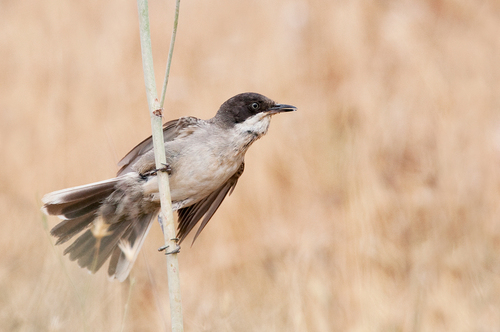
Eastern Orphean Warbler
Curruca crassirostris
With its piercing gaze and sophisticated song, the Eastern Orphean Warbler is a highlight of the Mediterranean summer. This elegant traveler brings a touch of wild melody to sun-drenched groves and backyard orchards.
Quick Identification
Size
Length of 15–16 cm (5.9–6.3 in); wingspan of 24–27 cm (9.4–10.6 in); weight ranges from 19–28 g (0.67–0.98 oz)
Colors
Males feature a striking black cap and white throat, with grey upperparts and pale underparts. Females and juveniles are duller, with a greyish-brown cap and buff-tinged flanks.
Key Features
- Distinctive black cap and stark white throat
- Pale, piercing yellowish-white iris (males)
- Relatively heavy, dark bill with a pale base
- Long tail with white outer feathers visible in flight
When You’ll See Them
Geographic range
Where Does the Eastern Orphean Warbler Live?
This species is a long-distance traveler native to the Palearctic region, stretching from the eastern Mediterranean and the Balkans through Turkey, the Caucasus, and into Central Asia. During the summer breeding months, it is commonly found in countries like Greece, Bulgaria, Iran, and Uzbekistan before migrating south across the Sahara. It winters primarily in the Sahel region and East Africa, making it a seasonal visitor to many suburban gardens across its migratory path.
Basemap © OpenStreetMap contributors
Behavior
The Eastern Orphean Warbler is a restless and somewhat secretive bird, often staying hidden within the canopy of tall shrubs or trees. Despite their elusive nature, they are highly vocal; the males are known for their loud, melodious, and thrush-like song, which is often the first sign of their presence in a backyard or woodland area. They are solitary during the breeding season and maintain distinct territories through song and display.
When foraging, they move through foliage with a deliberate, slow pace compared to other smaller warblers, searching for insects among the leaves. While they are not overly shy around human settlements, they rarely descend to the ground except to drink or bathe. During the pre-migration period, their behavior shifts as they become more focused on consuming high-energy fruits and berries to fuel their long journey to Africa.
EverydayEarth exclusive
Camera Tips
To capture the Eastern Orphean Warbler on camera, water is your best ally. These birds are frequently drawn to elevated bird baths or solar-powered drippers, especially in arid Mediterranean climates. Position your camera at eye level with the water source, ideally 4 to 6 feet (1.2–1.8m) off the ground, as they feel more secure drinking away from ground-level predators. Use a fast shutter speed or a 'sports' mode setting to freeze their quick movements while bathing.
Strategic placement near fruiting trees like figs, olives, or mulberries can also yield excellent results during the late summer. Set your camera to trigger on a 'high' sensitivity setting, as their movements within dense foliage can sometimes be subtle. Aim the lens at a clear 'landing branch'—a bare twig just outside the main fruit cluster where the bird is likely to pause before feeding.
Because these warblers are most active in the early morning, ensure your camera is positioned to avoid direct lens flare from the rising sun. If your camera supports it, use a burst mode (3-5 photos per trigger) to increase your chances of getting a clear shot of their distinctive white throat and pale eye. In suburban areas, they are more likely to visit gardens with mature, tall trees that provide a sense of canopy cover.
Similar Species
Species that look similar or are commonly confused with Eastern Orphean Warbler.
Frequently Asked Questions
Record Eastern Orphean Warbler at your habitat
Connect a camera to start building your own species record — AI identifies every visitor automatically.