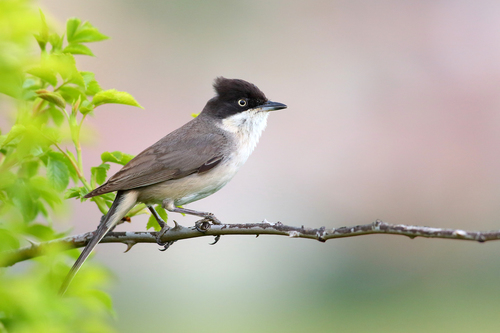
Western Orphean Warbler
Curruca hortensis
With its piercing pale eyes and sophisticated song, the Western Orphean Warbler is a crown jewel of the Mediterranean woodland. This robust traveler bridges the gap between European oak forests and the African Sahel.
Quick Identification
Size
Length: 15–16 cm (5.9–6.3 in); Wingspan: 22–25 cm (8.7–9.8 in); Weight: 18–28 g (0.6–1.0 oz)
Colors
Males feature a dark charcoal-grey cap and mask, a bright white throat, and pale yellowish-white irises. Females are browner overall with a lighter grey head.
Key Features
- Striking pale white or yellow iris
- Deep grey or blackish 'hood' extending below the eye
- Large, sturdy dark bill with a pale base
- Bright white throat contrasting with dark head
When You’ll See Them
Geographic range
Where Does the Western Orphean Warbler Live?
The Western Orphean Warbler is a native of the western Mediterranean basin, spanning across Southwestern Europe and Northwest Africa. Its core breeding grounds are found in Spain, Portugal, and Morocco, extending north into southern France and east into parts of Italy. As a long-distance migrant, this species spends its winters in the semi-arid Sahel region of Sub-Saharan Africa, stretching from Senegal and Mauritania eastward to Mali.
Basemap © OpenStreetMap contributors
Behavior
The Western Orphean Warbler is a somewhat shy and elusive bird, often preferring to remain concealed within the dense canopy of oak trees or olive groves. Despite its size—being one of the largest warblers in its genus—it can be surprisingly difficult to spot until it breaks into its rich, fluty song. During the breeding season, males are known for their 'song-flights,' where they rise into the air before parachuting back down to a prominent perch.
Unlike many smaller warblers that flit nervously between branches, the Western Orphean moves with a more deliberate, heavy manner. They are largely solitary outside of the breeding season and do not typically form large flocks, though they may congregate briefly at rich food sources like fruiting fig trees before their long autumn migration across the Sahara.
EverydayEarth exclusive
Camera Tips
To capture the Western Orphean Warbler on a backyard or trail camera, focus your efforts on the 'transition' zones of your property. These birds love the intersection of tall, mature trees and lower, berry-producing shrubs. If you live in a Mediterranean climate, placing your camera near olive, fig, or strawberry trees (Arbutus unedo) during the late summer will yield excellent results as the birds forage heavily for sugar-rich fruits before migration.
Water is a massive draw for this species, especially in the arid environments they prefer. A elevated birdbath or a dripper set up 2-3 feet off the ground will attract them much more effectively than a ground-level pond. Position your camera at eye-level with the water source, roughly 4 to 6 feet away, and ensure you use a 'macro' or 'close-focus' lens setting if your camera supports it, as these are medium-sized birds that require detail to distinguish from other warblers.
Because they are most active in the early morning, set your camera to take bursts of 3-5 photos or short 15-second videos. Their movements are slower than smaller warblers, but they still spend very little time in one spot. Aim your camera toward a horizontal 'landing branch' near a food or water source. In terms of timing, the best months for European captures are May and June when males are most vocal and active in defending territories.
Similar Species
Species that look similar or are commonly confused with Western Orphean Warbler.
Eastern Orphean Warbler
Nearly identical visually but found in the Balkans and Middle East; its song is more repetitive and less varied.
Sardinian Warbler
Smaller with a much darker black cap and a conspicuous red fleshy ring around the eye.
Lesser Whitethroat
Much smaller with a grey (not blackish) ear patch and dark irises rather than pale ones.
Frequently Asked Questions
Record Western Orphean Warbler at your habitat
Connect a camera to start building your own species record — AI identifies every visitor automatically.