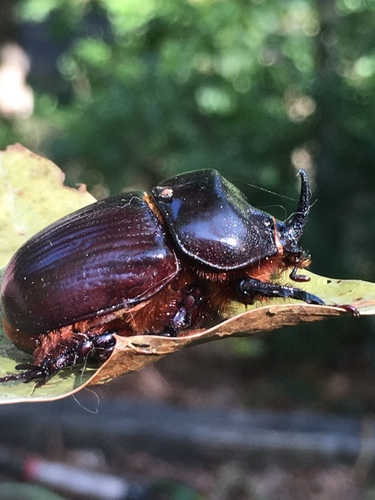
Eastern Rhinoceros Beetle
Xyloryctes jamaicensis
Meet North America's miniature titan: the Eastern Rhinoceros Beetle. A glossy, mahogany-colored marvel, this nocturnal weightlifter is famous for the male's impressive horn and its incredible strength.
Quick Identification
Size
25–38 mm (1.0–1.5 inches) in length; heavy, cylindrical body
Colors
Rich mahogany brown to glossy black; highly polished exoskeleton with a glass-like sheen
Key Features
- Single upward-curving horn on the head (males only)
- Deeply polished, dark chestnut to black wing covers
- Robust legs equipped with spines for digging and gripping
When You’ll See Them
Geographic range
Where Does the Eastern Rhinoceros Beetle Live?
This impressive beetle is native to North America, primarily occupying the Eastern and Central United States. Its range spans from the Atlantic coast as far west as Nebraska and Texas, and reaches north into Southern Ontario, Canada. While they are found throughout the American South and Midwest, they are most frequently spotted in regions where Ash trees and rich, deciduous loams are present.
Basemap © OpenStreetMap contributors
Behavior
During the day, these beetles are fossorial, meaning they spend their time buried beneath leaf litter or deep in soft soil to avoid predators and desiccation. They emerge at dusk, often using their surprisingly strong wings to fly toward light sources. Their movement on the ground is slow and deliberate, as they use their powerful, spiny legs to navigate through dense garden debris or mulch.
EverydayEarth exclusive
Camera Tips
To capture the Eastern Rhinoceros Beetle on an AI-powered camera, your best bet is to leverage their attraction to light. Position your camera near a low-UV porch light or a dedicated 'blacklight' setup against a white sheet. These beetles are heavy flyers and often crash-land near lights, where they will then crawl around for several minutes, providing excellent opportunities for clear, high-resolution photos.
For more natural behavioral shots, place your camera just a few inches off the ground near the base of a large Ash tree or a well-aged compost pile. Use a wide-angle setting if available, as these beetles are relatively large for insects and may appear blurry if they crawl too close to a standard macro lens. Since they are most active on humid, warm summer nights, ensure your camera's motion sensitivity is turned up to account for their slow, steady crawling pace.
If you find a 'spent' beetle during the day—often found near lights where they became stranded—you can place it on a textured log or a piece of bark in front of your camera to capture its impressive profile before it crawls back into the shade. Remember to enable your camera's infrared (IR) flash, as the beetle's glossy shell creates a stunning high-contrast silhouette against dark backgrounds.
Similar Species
Species that look similar or are commonly confused with Eastern Rhinoceros Beetle.
Frequently Asked Questions
Record Eastern Rhinoceros Beetle at your habitat
Connect a camera to start building your own species record — AI identifies every visitor automatically.