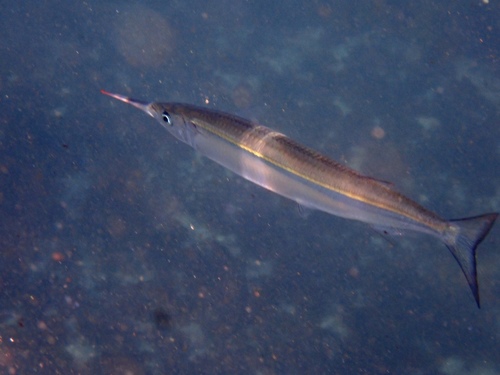
Eastern Sea Garfish
Hyporhamphus australis
A sleek, surface-skimming marvel of the Australian coast, the Eastern Sea Garfish is easily recognized by its 'half-beak' and shimmering silver scales. Often seen skipping across the waves in large schools, these fish are a vital part of the coastal ecosystem from Queensland to Norfolk Island.
Quick Identification
Size
Typically 30-40 cm (12-16 inches) in length, reaching a maximum of 45 cm (18 inches); weight usually ranges from 150-350g (5-12 oz).
Colors
Greenish-blue or olive on the back with a bright silvery-white belly; a distinct silver-blue lateral stripe runs along the body; the tip of the elongated lower jaw is often tipped with bright orange or red.
Key Features
- Extremely elongated lower jaw (beak) with a short, triangular upper jaw
- Slender, cylindrical, cigar-shaped body
- Forked tail with a noticeably larger lower lobe
- Dorsal and anal fins positioned far back near the tail
When You’ll See Them
Geographic range
Where Does the Eastern Sea Garfish Live?
The Eastern Sea Garfish is native to the temperate and subtropical waters of the southwestern Pacific Ocean. This species is found predominantly along the eastern coast of Australia, with its core population extending from southern Queensland through New South Wales to eastern Victoria. Beyond the mainland, they are also frequently recorded in the island territories of Lord Howe Island and Norfolk Island, thriving in both coastal reefs and protected inlets.
Basemap © OpenStreetMap contributors
Behavior
Eastern Sea Garfish are highly social surface-dwellers that form large, shimmering schools as a primary defense mechanism against predators. They spend the vast majority of their time in the top meter of the water column, where their counter-shaded coloring—dark on top and silver below—makes them nearly invisible to both birds above and larger fish below.
When threatened, these fish exhibit a remarkable 'skipping' behavior, launching themselves out of the water and skittering across the surface to evade capture. While generally shy, they are known to be curious about light sources at night, often congregating near piers or boats where artificial lighting is present. They are sensitive to water quality and are often viewed by coastal residents as indicators of a healthy estuarine ecosystem.
EverydayEarth exclusive
Camera Tips
Capturing the Eastern Sea Garfish requires an underwater setup or a very high-angle pier mount. For the best results, use a waterproof action camera mounted to a weighted tripod in shallow seagrass beds (approx. 0.5 to 1.5 meters deep). Angle the camera slightly upward toward the surface, as these fish spend their lives looking up and around the top layer of the water. High-frame-rate settings (60fps or higher) are essential to catch their fast, darting movements.
To attract a school to your camera's field of view, use 'chumming' or 'burleying' techniques. A fine mesh bag filled with soaked bread or oily fish mince (like sardine) suspended just below the surface will create a scent trail that draws them in. Because they are surface feeders, ensuring the bait stays afloat or suspended at the top of the water column is key to keeping the fish in frame.
Lighting is your biggest challenge and your best friend. During the day, a polarizing filter is a must-have for any camera mounted above the water to cut through the surface glare. At night, you can use a submerged green or white LED light; Eastern Sea Garfish are phototactic and will often school directly in the center of a light beam, providing excellent high-contrast footage against the dark water.
Pay attention to the tide when placing your camera. The best footage is typically captured during the last two hours of a rising tide or the first hour of a falling tide, as this is when the fish move into the shallowest parts of the estuaries to graze on seagrass. Ensure your camera housing is cleaned of salt spray or algae buildup daily for the clearest visibility.
Similar Species
Species that look similar or are commonly confused with Eastern Sea Garfish.
Frequently Asked Questions
Record Eastern Sea Garfish at your habitat
Connect a camera to start building your own species record — AI identifies every visitor automatically.