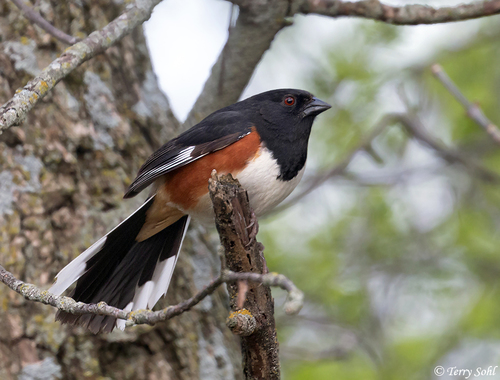
Eastern Towhee
Pipilo erythrophthalmus
With their striking 'drink-your-tea' song and bold rufous-sided plumage, Eastern Towhees are the charismatic giants of the sparrow world. These secretive ground-dwellers bring a splash of color and a rhythmic rustle to any brushy backyard.
Quick Identification
Size
Length: 17-23 cm (6.7-9.1 in); Wingspan: 20-30 cm (7.9-11.8 in); Weight: 33-49 g (1.2-1.7 oz)
Colors
Males have jet-black upperparts, a black hood, and a white belly with warm rufous (reddish-brown) flanks. Females share the same pattern but are rich chocolate-brown where the male is black.
Key Features
- Striking red eyes (white eyes in some Southeast US populations)
- Rich rufous-colored flanks contrasting with a white belly
- Long, rounded black tail with white outer feather tips
- Heavy, conical bill adapted for seeds and insects
When You’ll See Them
Sightings on EverydayEarth
May 31, 2026
A busy afternoon at the feeder station with several birds visiting. A Common Grackle is perched on the tube feeder to the right, foraging for seeds. On the central tray, a female Eastern Towhee feeds near an orange slice before flying off, later replaced by a male Eastern Towhee that lands on the tray's edge. A bright yellow American Goldfinch also flits through the background.
May 15, 2026
A male Red-winged Blackbird lands on the seed feeder and begins eating, showing off its bright red shoulder patches. Behind the central feeder support, an Eastern Towhee is partially visible, also foraging. The background shows a calm lake in the late afternoon light.
Geographic range
Where Does the Eastern Towhee Live?
The Eastern Towhee is native to the North American continent, primarily inhabiting the eastern half of the United States and southeast Canada. Its range extends from the Great Plains eastward to the Atlantic coast, with northern populations migrating to the southern U.S. and Gulf Coast for the winter, while southern populations remain year-round residents.
Basemap © OpenStreetMap contributors
Behavior
Eastern Towhees are the noisy percussionists of the forest floor. They are famous for their 'double-scratch' foraging technique, where they hop into the air and kick backward with both feet simultaneously to uncover insects buried in leaf litter. This creates a distinctive rustling sound that often makes them sound much larger than they actually are. While they spend most of their time on the ground, males will seek out high, exposed branches in the spring to proclaim their territory with their iconic 'drink-your-tea' song.
These birds are generally solitary or found in breeding pairs, maintaining a somewhat secretive lifestyle within dense thickets. Despite being members of the sparrow family, they don't typically flock with other species. They are highly territorial during the nesting season but may become slightly more tolerant during the winter months when food is scarce, occasionally appearing at the edges of backyard feeders if there is enough cover nearby.
EverydayEarth exclusive
Camera Tips
To capture the best footage of an Eastern Towhee, you must go low. Since they are ground-dwelling specialists, mount your camera only 6 to 12 inches off the ground. Aim the lens at 'transition zones'—the area where a manicured lawn meets a brush pile, or under the canopy of dense ornamental shrubs. If you have a thick layer of natural leaf litter, leave it undisturbed; this is their primary stage for the 'double-scratch' dance.
While towhees aren't as bold at feeders as Cardinals, they are easily lured with ground-scattered food. Use a mix of white proso millet and cracked corn spread directly on the dirt or on a low-profile tray feeder. Position your camera about 3-5 feet from the baiting area to capture the fine details of their striking red eyes and the contrast of their rufous flanks. Because they are shy, using a camera with a silent shutter or disabling any 'ready' beeps is essential.
Lighting is a challenge because towhees love shadows. Try to place your camera in an area that receives dappled morning light. If your camera allows for shutter speed adjustments, set it high (1/500s or faster) to freeze the motion of their scratching. In the heat of summer, a ground-level water dripper or shallow birdbath placed near cover is arguably the best way to get them to stay in front of the lens for an extended period.
Similar Species
Species that look similar or are commonly confused with Eastern Towhee.
Frequently Asked Questions
Record Eastern Towhee at your habitat
Connect a camera to start building your own species record — AI identifies every visitor automatically.