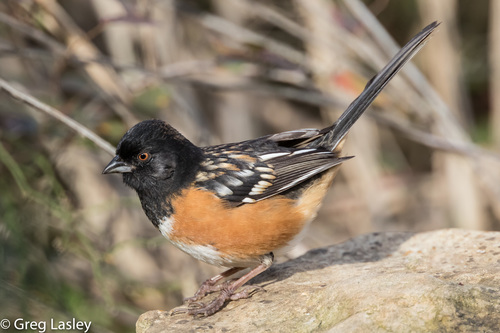
Spotted Towhee
Pipilo maculatus
With its striking red eyes and rhythmic 'double-scratch' hop, the Spotted Towhee is the flashy, secretive star of the backyard brush. Watch as this large, handsome sparrow transforms your garden's leaf litter into a bustling buffet.
Quick Identification
Size
Length: 6.7–8.3 in (17–21 cm); Wingspan: 11 in (28 cm); Weight: 1.2–1.7 oz (33–49 g)
Colors
Males feature a jet-black hood and back with white spotting on the wings; females are a dark soot-grey or brown. Both sexes have vibrant rufous flanks and a white belly.
Key Features
- Striking red iris (eye color)
- Extensive white spots/bars on dark wings and back
- Rufous-orange sides with a crisp white belly
- Two-footed 'double-scratch' foraging motion
When You’ll See Them
Behavior
The Spotted Towhee is a master of the undergrowth, often heard long before it is seen. Known for its distinctive foraging style, it uses a 'double-scratch' maneuver—a quick hop forward and a powerful synchronized kick backward with both feet—to uncover insects and seeds hidden beneath leaf litter. While they spend much of their time hopping through the shadows of dense shrubs, they are bold vocalists, often perching on high branches to deliver their buzzy, mechanical songs or their characteristic cat-like 'mew' call.
In suburban settings, these birds are common visitors but remain somewhat shy compared to bolder sparrows. They tend to stay near the edges of thickets or hedges, darting out into the open for a quick snack before retreating to cover. While they aren't strictly social like flocking starlings, you'll often find pairs or small family groups working the same patch of garden soil together, communicating with short, sharp contact calls.
EverydayEarth exclusive
Camera Tips
To capture the perfect shot of a Spotted Towhee, focus on their unique ground-level behavior. Since these birds are 'leaf-stirrers,' place your camera very low to the ground—no more than 6 to 12 inches high. Aim the lens at a patch of dry leaf litter or a cleared area near a dense hedge or brush pile. Because they move with a frantic, jerky 'double-scratch' motion, use a high shutter speed or a camera setting optimized for fast motion to avoid blurred action shots. If your camera allows for video, the scratching behavior is fascinating to watch in 10-20 second clips.
Towhees are creatures of habit and edge dwellers. They rarely venture into the middle of a wide-open lawn. Instead, position your camera along 'corridors'—the narrow transition zones between a garden bed and a fence, or underneath a low-hanging evergreen. To lure them into the camera's frame, you don't necessarily need a hanging feeder; instead, sprinkle a handful of sunflower hearts or a high-quality wild bird mix directly onto the ground or a low platform feeder. They are particularly fond of suet nuggets if placed where they feel safe from aerial predators.
Lighting is crucial because of their dark plumage. Deep shade can make the bird look like a silhouette, while bright midday sun can wash out the white spots on their wings. Early morning or late afternoon light provides the best contrast for those glowing red eyes. If you are using an AI-triggered camera, ensure the sensitivity is high enough to catch their quick movements, and try to position the setup so the background is a neutral color, allowing the bird's rufous sides and black hood to pop in the image. In winter, a heated birdbath can also be a magnet for towhees, providing great opportunities for 'splashing' photos.
Similar Species
Species that look similar or are commonly confused with Spotted Towhee.
Eastern Towhee
Identified by a solid black or brown back lacking the white spots characteristic of the Spotted Towhee; typically found in the Eastern US.
Dark-eyed Junco
Much smaller with a lighter pink beak and no rufous sides; lacks the red eye and distinct white wing spotting.
Varied Thrush
Features orange and black markings but has a distinct orange eyebrow stripe and a dark breast band, which towhees lack.
Frequently Asked Questions
Record Spotted Towhee at your habitat
Connect a camera to start building your own species record — AI identifies every visitor automatically.