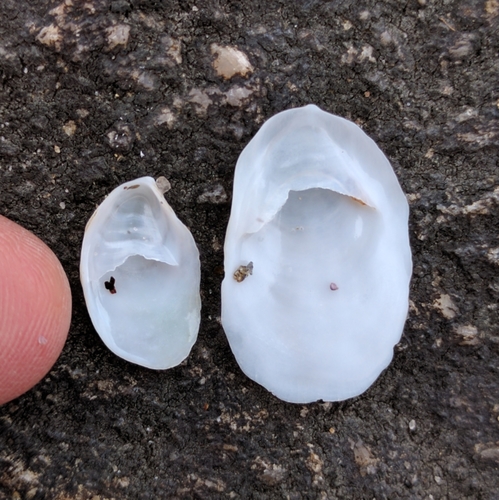
Eastern White Slippersnail
Crepidula plana
The 'ghost of the tide pool,' the Eastern White Slippersnail is a master of adaptation, growing paper-thin to fit inside the discarded homes of other sea creatures.
Quick Identification
Size
Shell length 20-38 mm (0.8-1.5 inches); height usually less than 5 mm (0.2 inches)
Colors
Uniformly milky white or translucent white; both the exterior shell and the internal 'deck' or shelf are white
Key Features
- Extremely flat, paper-thin shell profile
- Pure white color throughout with no spotting or stripes
- Large internal horizontal shelf covering nearly half the shell opening
- Often curved or twisted to fit the interior of host shells
When You’ll See Them
Geographic range
Where Does the Eastern White Slippersnail Live?
Native to the Western Atlantic Ocean, the Eastern White Slippersnail is a common sight along the coastlines of North America. Its core range extends from the chilly waters of Atlantic Canada through the entire Eastern Seaboard of the United States and down into the Gulf of Mexico. While it is a staple of the Atlantic coast, it has also been recorded as an introduced species in parts of Europe and the Pacific coast, likely transported via the global oyster trade. This snail is a hardy resident of both the intertidal zone and deeper offshore waters, thriving wherever suitable hard surfaces or empty shells are available for attachment.
Basemap © OpenStreetMap contributors
Behavior
As protandrous hermaphrodites, these snails exhibit a remarkable life cycle where they begin life as males and transition into females as they grow larger or as the social makeup of their local cluster changes. This transition is permanent; once a snail becomes female, it cannot revert to being male. Because they live in the tight confines of other shells, their own shells grow to be remarkably flat, sometimes even taking on a concave shape to perfectly match the curve of their host's home.
EverydayEarth exclusive
Camera Tips
To trigger an AI-powered camera, motion is key. While the snail itself moves very slowly, the hermit crab carrying it will provide the necessary movement to start a recording. Place a weighted bait cage containing a small piece of fish or crushed blue crab in the center of the frame. This will attract mobile hosts (like hermit crabs or larger predatory snails) that are likely carrying the Eastern White Slippersnail. Ensure your camera is mounted low and angled slightly upward to catch a glimpse of the snail attached inside the aperture of the host shell.
Lighting is your biggest challenge underwater. If the water is shallow, mid-day sun provides the best natural illumination to showcase the snail's pure white shell against darker backgrounds. For deeper setups, a small, diffused underwater LED light can help the AI distinguish the snail's white form from the sand or mud. Use a high-resolution setting (at least 2.7K) because the distinguishing features, like the internal shelf, are small and require clarity to identify correctly.
Similar Species
Species that look similar or are commonly confused with Eastern White Slippersnail.
Frequently Asked Questions
Record Eastern White Slippersnail at your habitat
Connect a camera to start building your own species record — AI identifies every visitor automatically.