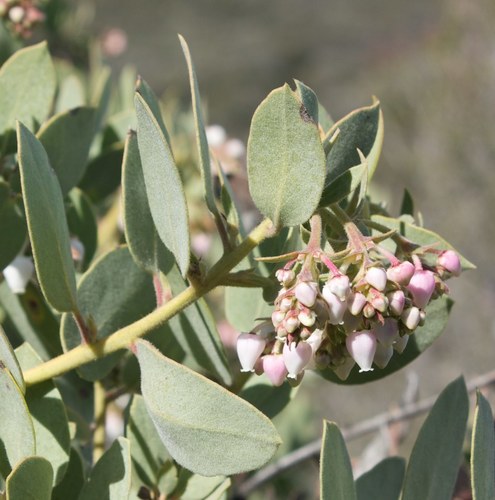
Eastwood's Manzanita
Arctostaphylos glandulosa
With its striking red bark and delicate bell-shaped flowers, Eastwood's Manzanita is the architectural gem of the West Coast chaparral. A master of survival, this fire-resilient shrub is a vital hub for hummingbirds, bees, and foraging mammals.
Quick Identification
Size
Grows 1 to 4 meters (3 to 13 feet) tall, with a spreading canopy that can reach 2 to 5 meters (6 to 16 feet) wide.
Colors
Smooth mahogany-red bark, grey-green to bright green leathery leaves, and clusters of white to pale pink bell-shaped flowers.
Key Features
- Swollen woody base (basal burl) for fire recovery
- Glandular, sticky hairs on young twigs and flower stalks
- Deep mahogany-red, peeling bark on older branches
- Urn-shaped flowers in drooping clusters
When You’ll See Them
Geographic range
Where Does the Eastwood's Manzanita Live?
Native to the western edge of North America, Eastwood's Manzanita is a classic sentinel of the Pacific coast. Its core range extends from the rugged mountains of southern Oregon southward through the California Coast Ranges and Sierra Nevada foothills, reaching its southern limit in the northern reaches of Baja California, Mexico. It is perfectly adapted to the Mediterranean climate, thriving in regions characterized by wet winters and parched, hot summers.
Basemap © OpenStreetMap contributors
Behavior
Eastwood's Manzanita is a hardy, long-lived shrub known for its resilience in the face of environmental stress. Unlike many other manzanita species that die completely during wildfires and rely solely on seeds to regenerate, this species possesses a 'lignotuber' or basal burl. This thickened woody mass at the base of the stem contains dormant buds and energy reserves, allowing the plant to resprout vigorously from the ground even after its entire canopy has been consumed by flames.
Ecologically, it serves as a cornerstone of the chaparral community. It is an 'early mover' in the seasonal cycle, blooming in late winter when most other plants are still dormant. This provides a vital nectar source for early-emerging native bees and resident hummingbirds. As the flowers fade, they develop into small, apple-like fruits that provide a high-energy food source for a wide variety of backyard and wilderness visitors.
EverydayEarth exclusive
Camera Tips
Capturing Eastwood's Manzanita on camera is less about movement and more about showcasing its architectural beauty as a backdrop for wildlife. To highlight its stunning mahogany bark, place your camera at a low angle (1-2 feet off the ground) pointing slightly upward toward a major branch junction. This perspective captures the peeling texture of the bark and provides a natural 'stage' where lizards or small birds often perch to survey their surroundings.
During the blooming season in late winter, position your camera near a cluster of the white, bell-shaped flowers. This is an ideal setup for capturing high-speed footage of Anna's Hummingbirds or bumblebees. Because these flowers are often pale, ensure the camera is south-facing to take advantage of the low winter sun, which will make the translucent petals glow against the dark green foliage without overexposing the image.
In the summer months, focus your lens on the ripening fruit clusters. These 'little apples' are a major draw for larger mammals like coyotes and foxes. If you are using a trail camera to track wildlife, placing it near a mature Eastwood's Manzanita is a winning strategy; the dense, evergreen structure provides excellent cover for animals, making them feel secure enough to pause and forage in front of your lens. Use a fast trigger speed to catch the quick movements of California Scrub-Jays as they harvest the berries.
Similar Species
Species that look similar or are commonly confused with Eastwood's Manzanita.
Frequently Asked Questions
Record Eastwood's Manzanita at your habitat
Connect a camera to start building your own species record — AI identifies every visitor automatically.