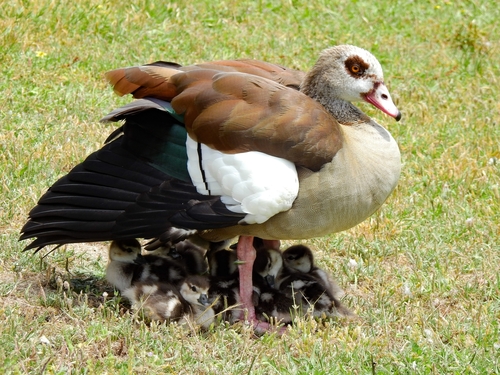
Egyptian Goose
Alopochen aegyptiaca
With its striking chocolate-brown eye patches and regal posture, the Egyptian Goose is a captivating sight in both wild wetlands and suburban parks. Originally an icon of ancient Egyptian art, this resilient species has successfully expanded across the globe.
Quick Identification
Size
Length: 63–73 cm (25–29 in); Wingspan: 135–155 cm (53–61 in); Weight: 1.5–2.3 kg (3.3–5.1 lbs)
Colors
Pale brown to greyish body, dark brown eye patches, dark brown neck ring, white wing patches with iridescent green speculum, pink legs and bill
Key Features
- Dark chocolate-brown 'mask' around the eyes
- Prominent white wing patches visible in flight
- Small dark chestnut patch in the center of the breast
- Long, bubblegum-pink legs and a pale pink bill with a black tip
When You’ll See Them
Sightings on EverydayEarth
Aug 2, 2026
A large African Elephant stands prominently in the center-left of the scene, occasionally flapping its ears. In the background, a herd of Blue Wildebeest is moving across the dry, dusty ground, kicking up a small cloud of dust as they travel. In the foreground, two Egyptian Geese are perched near the water's edge at the bottom right.
Aug 2, 2026
Several hippopotamuses are resting in a watering hole, with some mostly submerged and one larger individual partially on a muddy bank. Three Egyptian Geese are perched on a fallen log in the middle of the water. In the background, a common warthog emerges from the brush on the left and walks across the far bank.
Aug 1, 2026
Two Egyptian Geese are at the edge of a waterhole at night. One bird lowers its head to drink from the water, while the other stands alert, occasionally turning its head and shifting its weight. The still surface of the water provides a clear reflection of both birds.
Aug 1, 2026
Two Egyptian Geese are resting at the edge of a waterhole at night. The goose in the foreground on the left is actively preening its wing feathers, while the second goose stands alert further back on the right bank.
Aug 1, 2026
Under the cover of night, several hippopotamuses are resting in the calm waters of the pan. Some are submerged in the center, while a small cluster is gathered near the right bank. Along the same shoreline, a group of Egyptian Geese are standing quietly, occasionally shifting their positions. The foreground is dominated by a brightly illuminated, weathered tree stump and dry grasses.
Aug 1, 2026
A group of hippopotamuses is resting in the river, occasionally surfacing to breathe. On the far bank, two reticulated giraffes walk across the dry, brushy hillside. Several water birds are present, including an African fish-eagle perched on a mid-river rock and multiple Egyptian geese standing on the banks and rocks.
Geographic range
Where Does the Egyptian Goose Live?
Native to the vast landscapes of Africa, the Egyptian Goose is found across almost the entire continent south of the Sahara and throughout the Nile Valley. Because of its historical popularity as an ornamental species, it has successfully established wild, self-sustaining populations across Western Europe, particularly in the United Kingdom, the Netherlands, and Germany. In North America, they are now a common sight in the warmer climates of Florida, Texas, and California, where they thrive in suburban wetlands and managed landscapes.
Basemap © OpenStreetMap contributors
Recorded on EverydayEarth
Behavior
Egyptian Geese are highly territorial and social birds, often found in pairs or small family units rather than large flocks. Despite their name, they are technically a 'sheldgoose,' a bridge between ducks and geese. They are known for being extremely vocal; males make a raspy, wheezy hiss, while females produce a loud, repetitive honking 'ark-ark-ark' when disturbed or defending their space.
These birds are equally comfortable on land as they are in the water. They spend a significant portion of their day grazing on short grass or sunning themselves on banks. During the breeding season, they become exceptionally aggressive toward other waterfowl and even humans if they perceive a threat to their nest. They are also known for their unusual nesting habits, sometimes utilizing old nests of other large birds high up in trees or on building ledges.
EverydayEarth exclusive
Camera Tips
To capture the best footage of Egyptian Geese, position your camera near the water's edge or at the transition point between a pond and a grassy lawn. These birds are tall, so mount your camera about 12 to 18 inches off the ground. Angling the camera slightly upward can create a more majestic, 'eye-level' profile that highlights their distinctive facial markings and chestnut breast patch.
While they are natural grazers, you can encourage them to linger in front of your lens by scattering a small amount of cracked corn or specialized waterfowl pellets. They are creatures of habit and will often return to the same spot every morning to forage. If your camera has a 'burst' or 'rapid-fire' mode, enable it; these geese have a beautiful flight take-off and landing sequence where their massive white wing patches are most visible.
Pay attention to the light during the 'golden hours' of dawn and dusk. Egyptian Geese are most active during these times, and the low sun highlights the subtle iridescent green in their wings. If you are monitoring a nesting pair, keep the camera at a respectful distance to avoid causing stress, as they can be quite protective. Using a camera with high-quality audio recording is a bonus, as their unique hissing and honking calls add a lot of character to the captured video.
Similar Species
Species that look similar or are commonly confused with Egyptian Goose.
Frequently Asked Questions
Record Egyptian Goose at your habitat
Connect a camera to start building your own species record — AI identifies every visitor automatically.