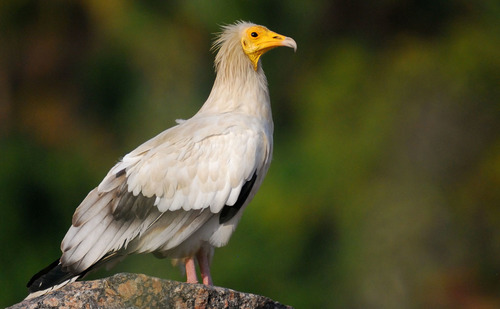
Egyptian Vulture
Neophron percnopterus
Known as the 'Pharaoh’s Chicken,' the Egyptian Vulture is a remarkable tool-using raptor with striking white plumage and a bright yellow face. This intelligent scavenger plays a vital role in our ecosystems, cleaning the landscape across Europe, Africa, and Asia.
Quick Identification
Size
Length 58-70 cm (23-28 in), wingspan 155-170 cm (61-67 in), weight 1.6-2.2 kg (3.5-4.85 lbs)
Colors
Adults are mostly white with black flight feathers; face is bare yellow skin; juveniles are dark brown with black/grey faces
Key Features
- Distinctive wedge-shaped white tail in flight
- Bare yellow skin on the face and throat
- Contrasting black primary and secondary wing feathers
- Relatively small, slender bill compared to other vultures
When You’ll See Them
Geographic range
Where Does the Egyptian Vulture Live?
This wide-ranging vulture spans across three continents, with populations found from the Iberian Peninsula and North Africa through the Middle East and into the Indian subcontinent. While some populations in Europe and Central Asia are long-distance migrants that winter in sub-Saharan Africa, those in India and parts of Africa remain year-round residents. They favor open landscapes where they can easily spot food from the air, often nesting on rugged cliffs or high rocky outcrops.
Basemap © OpenStreetMap contributors
Behavior
The Egyptian Vulture is one of the most intelligent raptors in the world, famously known for being one of the few bird species to use tools. They are frequently observed picking up stones in their beaks and tossing them at large eggs, such as those of ostriches, to crack the shells. Beyond this clever strategy, they are highly opportunistic scavengers that fill a unique ecological niche, often being the last to arrive at a carcass to pick off the small scraps of meat left behind by larger vultures.
Socially, these birds are often seen alone or in pairs, though they may congregate in larger numbers at communal roosting sites or near abundant food sources like refuse dumps. While they are wary of direct human contact, they have lived alongside people for millennia—earning the name 'Pharaoh’s Chicken' in Egypt due to their historical significance and tendency to scavenge near ancient settlements. They spend much of their day soaring on thermals, scanning the ground with exceptionally keen eyesight.
EverydayEarth exclusive
Camera Tips
To capture the Egyptian Vulture on a trail camera, focus on high-vantage points or open ground near suspected feeding sites. Because these birds are scavengers, placing your camera near livestock carcasses or even suburban refuse areas (where safe and legal) is highly effective. Set your camera at a low angle, about 1 to 2 feet off the ground, pointed toward a clearing. This provides an intimate perspective of the bird's unique yellow face and 'shaggy' neck feathers as it walks on the ground.
While we don't recommend leaving raw meat out due to health and predator concerns, these birds are attracted to 'vulture restaurants'—established feeding stations managed by conservationists. If you are in a rural area, a fresh water source or a birdbath located in a wide-open area can also entice them down from the sky. They are most active during the warmest parts of the day when thermals are strongest, so ensure your camera’s PIR sensor is adjusted for higher temperatures and that the sun isn't pointing directly into the lens during midday.
Given their status as an Endangered species, the Egyptian Vulture is naturally wary. Use a camera with a 'No Glow' or 'Invisible' IR flash to avoid spooking them during early morning or late evening visits. A fast trigger speed (0.3s or less) is essential, as they can be surprisingly quick when competing for scraps or taking flight. If you're setting up near a nest site, maintain a significant distance and use a telephoto-capable setup or a long-range trigger to ensure you do not disturb their breeding cycle, which is protected by law in most regions.
Similar Species
Species that look similar or are commonly confused with Egyptian Vulture.
Frequently Asked Questions
Record Egyptian Vulture at your habitat
Connect a camera to start building your own species record — AI identifies every visitor automatically.