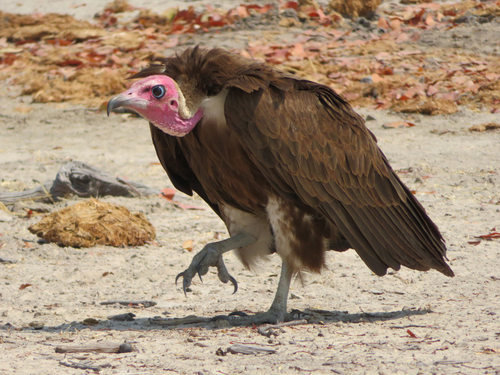
Hooded Vulture
Necrosyrtes monachus
The Hooded Vulture is Africa's scruffy and resilient neighborhood cleaner. Despite being critically endangered, this intelligent bird is a master of living alongside humans, providing essential sanitation services for villages and savannas alike.
Quick Identification
Size
Length: 62–72 cm (24–28 in); Wingspan: 155–180 cm (61–71 in); Weight: 1.5–2.6 kg (3.3–5.7 lb)
Colors
Dark brown body plumage; bare pale pinkish-red face and crown; white-to-light-brown downy feathers on the back of the neck; no significant difference between males and females.
Key Features
- Distinctive thin, hooked bill for reaching into small crevices
- Bare, pale pink face that turns bright red when excited
- Relatively small and scruffy appearance compared to other vultures
- Downy white feathers on the nape and hind-neck
When You’ll See Them
Geographic range
Where Does the Hooded Vulture Live?
The Hooded Vulture is native to sub-Saharan Africa, where it occupies a vast range across West, East, and Southern Africa. While it is found in numerous countries including Nigeria, Ethiopia, and South Africa, the highest population densities are currently found in the western regions of The Gambia and Guinea-Bissau. Despite its wide distribution, many local populations have seen catastrophic declines, particularly in areas like Senegal where numbers have dropped by over 85% in recent decades.
Basemap © OpenStreetMap contributors
Behavior
The Hooded Vulture is one of the most approachable and visible vultures in Africa, often living in close proximity to humans. Unlike many of its larger cousins that avoid urban centers, these birds are common sights around slaughterhouses, markets, and village edges where they scavenge for food scraps. They are highly social, often seen in small groups perched in trees or on rooftops, waiting for an opportunity to feed.
In the wild, they are typically the first to arrive at a carcass. Because of their smaller size and thinner beak, they cannot tear through tough hides like the larger Gyps vultures can. Instead, they wait on the periphery of a feeding frenzy, darting in to grab small scraps or specialized bits that other scavengers miss. They are also known to follow human activity, such as plowing, to catch insects and small vertebrates disturbed by the machinery.
EverydayEarth exclusive
Camera Tips
Capturing a Hooded Vulture on a backyard or trail camera requires understanding their reliance on thermals and human activity. If you live within their range, place your camera in an open area with clear visibility to the sky. These birds are often attracted to the scent of food or the sight of other scavengers. Positioning the camera near a consistent water source or an area where organic waste is managed can yield excellent results, as they are frequent visitors to 'cleaning stations' near human habitations.
For the best angle, mount your camera approximately 3 to 5 feet off the ground, angled slightly downward. This height captures their natural walking gait and social interactions on the ground. If you have a large tree that serves as a known roost, mounting a camera on a nearby structure aimed at the lower branches can capture incredible footage of their preening and 'blushing' behavior, where their facial skin changes color based on their mood and social state.
Because Hooded Vultures are most active during the warmest parts of the day when they can utilize rising air currents, set your camera to a high shutter speed or use 'Burst Mode' to catch the action. They are surprisingly fast when competing for food scraps. In suburban areas, they are less wary of technology than other raptors, so you don't need excessive camouflage, but ensuring the camera is secure is vital, as their curiosity might lead them to peck at the lens or casing.
Similar Species
Species that look similar or are commonly confused with Hooded Vulture.
Frequently Asked Questions
Record Hooded Vulture at your habitat
Connect a camera to start building your own species record — AI identifies every visitor automatically.