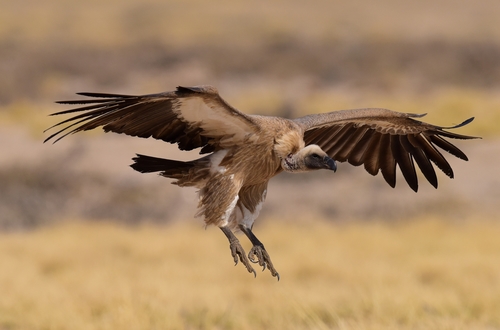
White-backed Vulture
Gyps africanus
The White-backed Vulture is the industrious cleaner of the African savanna, a social giant known for its incredible soaring ability and vital role in the ecosystem. With a massive wingspan and a keen eye, they are a spectacular sight for any backyard or trail camera enthusiast in their range.
Quick Identification
Size
Length: 31–39 in (78–98 cm); Wingspan: 6.4–7.4 ft (1.96–2.25 m); Weight: 9.3–15.9 lb (4.2–7.2 kg)
Colors
Brownish-grey body plumage with a contrasting white patch on the lower back and rump; dark, unfeathered neck and head with a pale white feather ruff at the base.
Key Features
- Distinct white patch on lower back visible in flight
- Long, dark, sparsely feathered neck
- Broad, square-ended wings with dark flight feathers
- Short, dark tail and dark bill
When You’ll See Them
Sightings on EverydayEarth
Apr 10, 2026
A large group of White-backed Vultures has gathered at the edge of a waterhole. Several birds are drinking, while others stand nearby or adjust their wings. In the background, partially obscured by the trees on the left, a Cape Buffalo stands watching the scene.
Apr 10, 2026
A bright, sunny morning at a waterhole in the African bush. A vulture is perched on the right bank, watching the water. In the background, a warthog runs quickly across the landscape from right to left with its tail held high. A second vulture flies low over the water, circling the area before soaring away to the right.
Behavior
The White-backed Vulture is the most gregarious and social of Africa's vultures. They are masters of communal living, often seen roosting together in tall trees or spiraling in large groups called "kettles" as they ride thermal air currents. Their social nature is most evident at a carcass, where dozens of birds may congregate in a noisy, fluttering group to feed, relying on a complex hierarchy to determine who eats first.
These birds spend most of their day soaring at high altitudes, using their incredible eyesight to scan the ground for carrion or to watch the behavior of other scavengers. They are highly efficient "cleaners" of the savanna, able to strip a carcass of its soft tissue in a remarkably short time, which helps prevent the spread of diseases in the ecosystem. While they are bold around a meal, they are generally shy around humans and will maintain a safe distance unless accustomed to a specific feeding site.
EverydayEarth exclusive
Camera Tips
To capture the majesty of the White-backed Vulture, camera placement is everything. Because they are massive birds that often arrive in groups, you need to think big. Avoid tight spots; instead, aim your camera at wide-open clearings or near large, isolated water troughs where they come to bathe and drink. If you are on a property with livestock, a camera placed 20-30 yards from a safe carcass-disposal area (a "vulture restaurant") will yield incredible results. Set the camera at a low angle, roughly 1 to 2 feet off the ground, to capture their dinosaur-like gait and the dramatic scale of their 7-foot wingspan as they land.
Lighting and timing are the second critical factors. Vultures are "thermal fliers," meaning they rarely take to the air until the sun has warmed the ground enough to create rising air currents. Program your camera to be most active between 10 AM and late afternoon. If you’re targeting a roosting site, focus on the tops of tall, dead trees (snags). In these cases, mount your camera higher—about 10-15 feet up a neighboring tree—pointing slightly upward to catch them as they spread their wings to catch the morning sun, a behavior known as the "horaltic pose."
For technical settings, use a high-speed trigger and a multi-shot burst mode. Vulture activity is often chaotic, with birds hopping, wing-slapping, and jostling for position. A burst of 3-5 images will help you catch that one perfect frame of a bird in full flight or mid-display. Use a high ISO sensitivity if your camera is in a shaded area, but be careful with exposure compensation—the white patch on their back can easily "blow out" and lose detail in direct, harsh midday sun. If using an AI camera, ensure it is set to recognize large motion signatures to avoid missing these giants as they drop rapidly from the sky.
Similar Species
Species that look similar or are commonly confused with White-backed Vulture.
Frequently Asked Questions
Record White-backed Vulture at your habitat
Connect a camera to start building your own species record — AI identifies every visitor automatically.