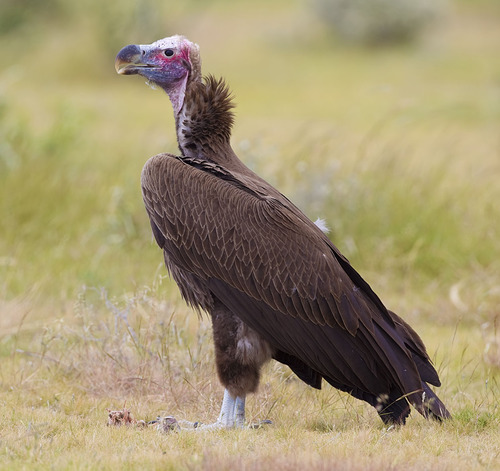
Lappet-faced Vulture
Torgos tracheliotos
The Lappet-faced Vulture is the powerhouse of the African savanna, possessing a beak strong enough to tear through the toughest hides. As an Endangered giant of the skies, seeing one on your camera is a rare and vital sign of a healthy ecosystem.
Quick Identification
Size
Length 95–115 cm (37–45 in); Wingspan 2.5–2.9 m (8.2–9.5 ft); Weight 4.4–9.4 kg (9.7–20.7 lb)
Colors
Dark brown to black body feathers with white down on the thighs and belly. The head is bare, ranging from dull pink to deep red, featuring prominent fleshy folds of skin called lappets.
Key Features
- Massive hooked bill, the largest of any vulture
- Naked pink or reddish head with distinct skin folds
- Large white 'trousers' of feathers on the legs
- Gigantic wingspan with broad, rectangular wings
When You’ll See Them
Geographic range
Where Does the Lappet-faced Vulture Live?
Native to the vast landscapes of Africa and the Arabian Peninsula, the Lappet-faced Vulture is a master of the arid wilderness. Its primary strongholds are found in the Sahel region, throughout East Africa's savanna belt, and across the rugged deserts of Southern Africa, including Namibia and Botswana. While they were once more widespread, they are now primarily restricted to protected national parks and remote areas within countries like South Africa, Kenya, and Saudi Arabia.
Basemap © OpenStreetMap contributors
Behavior
The Lappet-faced Vulture is the undisputed king of the carcass. Unlike many other vulture species that are highly social and feed in large, frantic groups, the Lappet-faced is often solitary or found in pairs. They are usually the last to arrive at a kill, but their presence immediately commands respect; their sheer size and powerful beak allow them to bully smaller vultures and even jackals away from a meal.
Their specialized physiology allows them to fill a unique ecological niche. While other vultures focus on soft tissue and organs, the Lappet-faced Vulture uses its massive, heavy bill to rip through the toughest hides, tendons, and ligaments of large mammals like elephants or buffalo. This role is crucial, as it 'opens up' the carcass for smaller scavengers that lack the strength to pierce thick skin.
These birds are remarkably long-lived and form stable pairs. They build enormous nests—sometimes reaching over 2 meters in diameter—at the tops of thorny acacia trees. Despite their power, they are incredibly wary of human presence and are unfortunately prone to secondary poisoning, which has contributed to their status as an endangered species.
EverydayEarth exclusive
Camera Tips
Capturing the Lappet-faced Vulture on camera requires patience and strategic placement. Because these birds are large-bodied and rely on thermals to fly, they are most active once the sun has warmed the ground. Aim to place your cameras near established waterholes or in open areas where large mammal carcasses are likely to occur. Given their height—standing over three feet tall—set your camera about 2 to 3 feet off the ground and angle it slightly upward to capture their full profile.
If you are using a camera on a private conservancy or farm, focus on 'vulture restaurants' or areas where supplemental feeding occurs. Use a wide-angle setting if your camera allows it; these birds have a nearly 10-foot wingspan, and a standard tight crop will often cut off their impressive wingtips during landing or takeoff. High-speed triggers are essential, as the interaction between vultures at a carcass can be lightning-fast despite their bulky size.
Avoid placing cameras too close to nests, as this species is highly sensitive to disturbance and may abandon eggs if they feel threatened. Instead, look for 'perch trees'—usually the tallest isolated acacias in the area—where they often sit for hours scanning the horizon. Use burst mode (3-5 photos per trigger) to ensure you capture the distinctive pink skin folds of the head, which can change in intensity based on the bird's excitement level.
Similar Species
Species that look similar or are commonly confused with Lappet-faced Vulture.
Frequently Asked Questions
Record Lappet-faced Vulture at your habitat
Connect a camera to start building your own species record — AI identifies every visitor automatically.