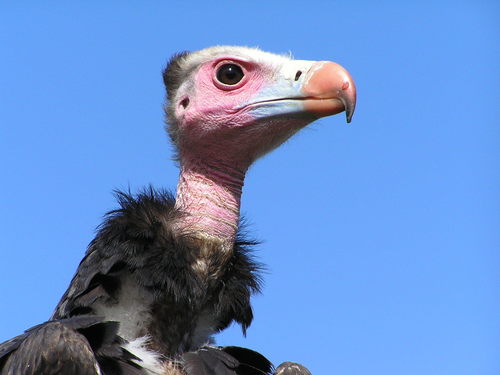
White-headed Vulture
Trigonoceps occipitalis
A rare and striking avian predator, the White-headed Vulture stands out with its bright pink beak and iconic white crown. This critically endangered scavenger is a true indicator of a healthy, undisturbed African wilderness.
Quick Identification
Size
Length 72–85 cm (28–33 in), wingspan 207–230 cm (81–90 in), weight 3.3–5.3 kg (7.3–11.7 lb)
Colors
Blackish-brown plumage with white belly and thighs; bright pinkish-orange beak and cere; distinctive white downy crown. Females show white on the inner secondary feathers.
Key Features
- Distinctive white downy crest on a triangular head
- Bright pinkish-orange beak and facial skin
- Large white patches on the belly and thighs
- Broad, square-ended wings in flight
When You’ll See Them
Geographic range
Where Does the White-headed Vulture Live?
The White-headed Vulture is a majestic resident of sub-Saharan Africa, found across a vast stretch of the continent from the semi-arid regions of West Africa to the lush savannas of East and Southern Africa. Its core range includes protected wilderness areas in countries like South Africa, Botswana, Kenya, and Tanzania, where it avoids human settlements in favor of undisturbed landscapes. While its presence spans from the Sahel down to the northern parts of South Africa, populations are increasingly fragmented, making it a rare and special sight for wildlife enthusiasts.
Basemap © OpenStreetMap contributors
Behavior
Unlike many of its social cousins, the White-headed Vulture is a relatively solitary bird, often seen alone or in pairs rather than in large communal groups. It is frequently the first to arrive at a carcass, using its keen eyesight to spot a kill before the more dominant species move in. Despite being early to the feast, it is easily intimidated by larger vultures and often feeds on the periphery or snatches small scraps before retreating.
Interestingly, this species is much more of an active predator than other Old World vultures. It has been observed hunting small mammals, reptiles, and even other birds, making it a versatile opportunist. In its interactions with humans, it is notoriously shy and wary, strictly avoiding areas with high human density or significant habitat disturbance, which has contributed to its vulnerability as land is developed.
EverydayEarth exclusive
Camera Tips
To capture the elusive White-headed Vulture on a trail camera, focus on the periphery of known watering holes or large, open clearings within protected savanna habitats. Because these birds are incredibly wary of human activity, your camera must be exceptionally well-camouflaged. Use natural vegetation to break up the outline of the device, and ensure there are no shiny surfaces or blinking status lights that might startle the bird as it lands.
The ideal camera height is approximately 1 to 1.5 meters off the ground, angled slightly downward if placed on a ridge or overlooking a flat feeding area. Since these vultures often land several meters away from a carcass and walk in, a wide-angle lens or a camera with a fast trigger speed (under 0.3 seconds) is essential to capture them in motion. Set your camera to take bursts of 3-5 photos or short 10-second videos, as their behavioral cues—like the way they tilt their white-crested heads—are best captured in sequences.
While traditional 'backyard' lures won't work for this species, placing cameras near natural carcasses in a safe, legal manner on large conservancies is the most effective method. They are most active during the heat of the day when thermals allow for easy soaring, so ensure your camera's exposure settings are optimized for bright, harsh sunlight to avoid blowing out the white details on their heads and bellies.
Seasonal considerations are important; during the dry season, vultures congregate more reliably around the few remaining water sources. Positioning a camera near a secluded 'vulture restaurant' or a remote pan in a national park (with permission) during the winter months provides the highest probability of a successful capture. Always use high-endurance SD cards, as the African sun and heat can be taxing on electronic components.
Similar Species
Species that look similar or are commonly confused with White-headed Vulture.
Lappet-faced Vulture
Much larger with a massive yellow beak and naked reddish skin on the head, lacking the white downy crest.
White-backed Vulture
Duller brownish plumage, lacks the pink beak and white crown, and is much more social, often seen in large groups.
Hooded Vulture
Smaller with a thin, dark beak and a woolly brown 'hood' rather than a white triangular crest.
Frequently Asked Questions
Record White-headed Vulture at your habitat
Connect a camera to start building your own species record — AI identifies every visitor automatically.